Congresses of Entomology (ICE)
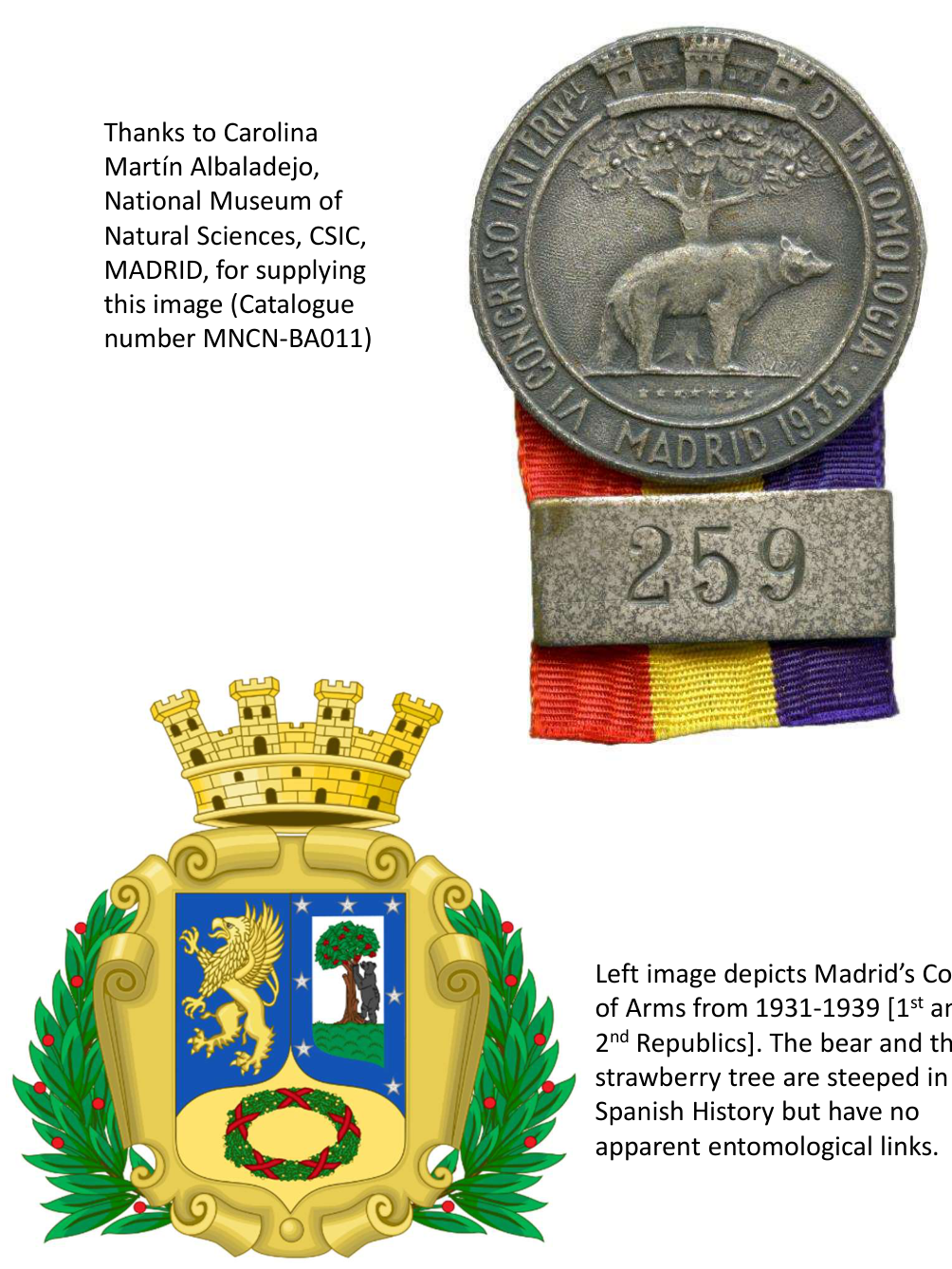
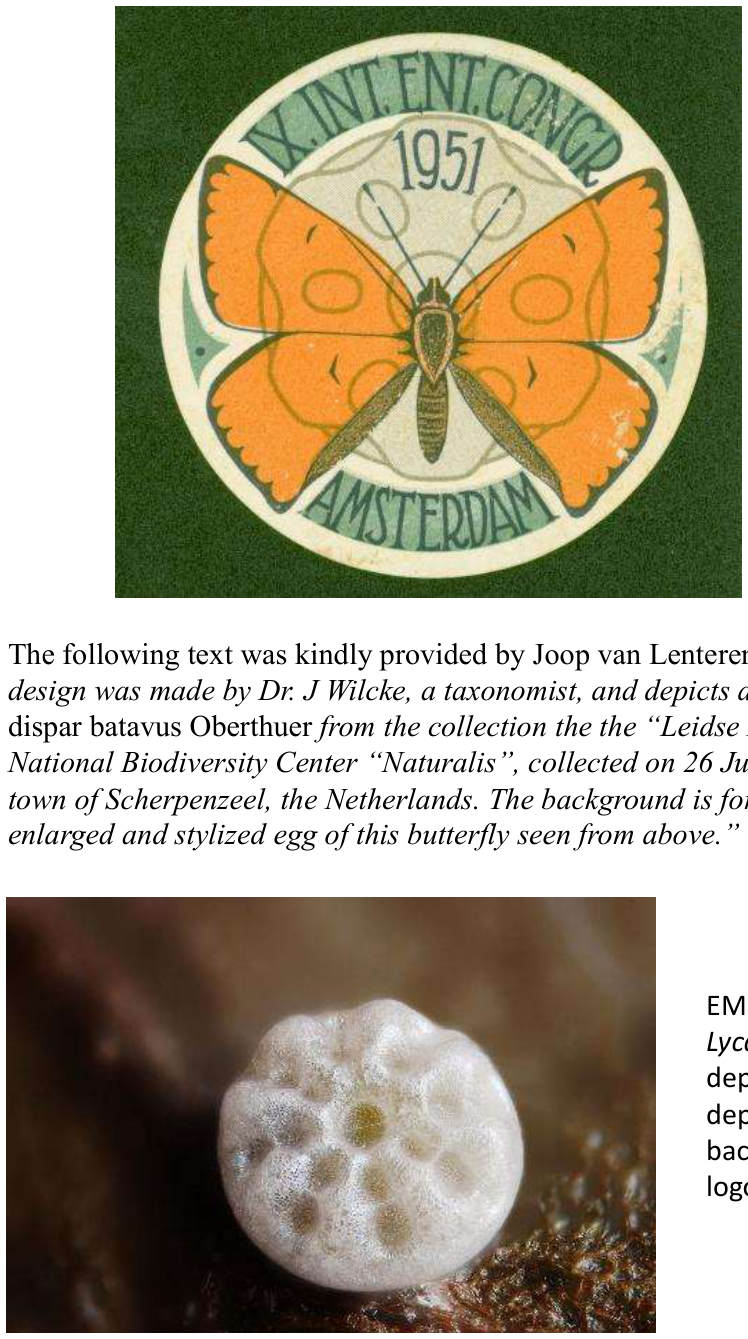
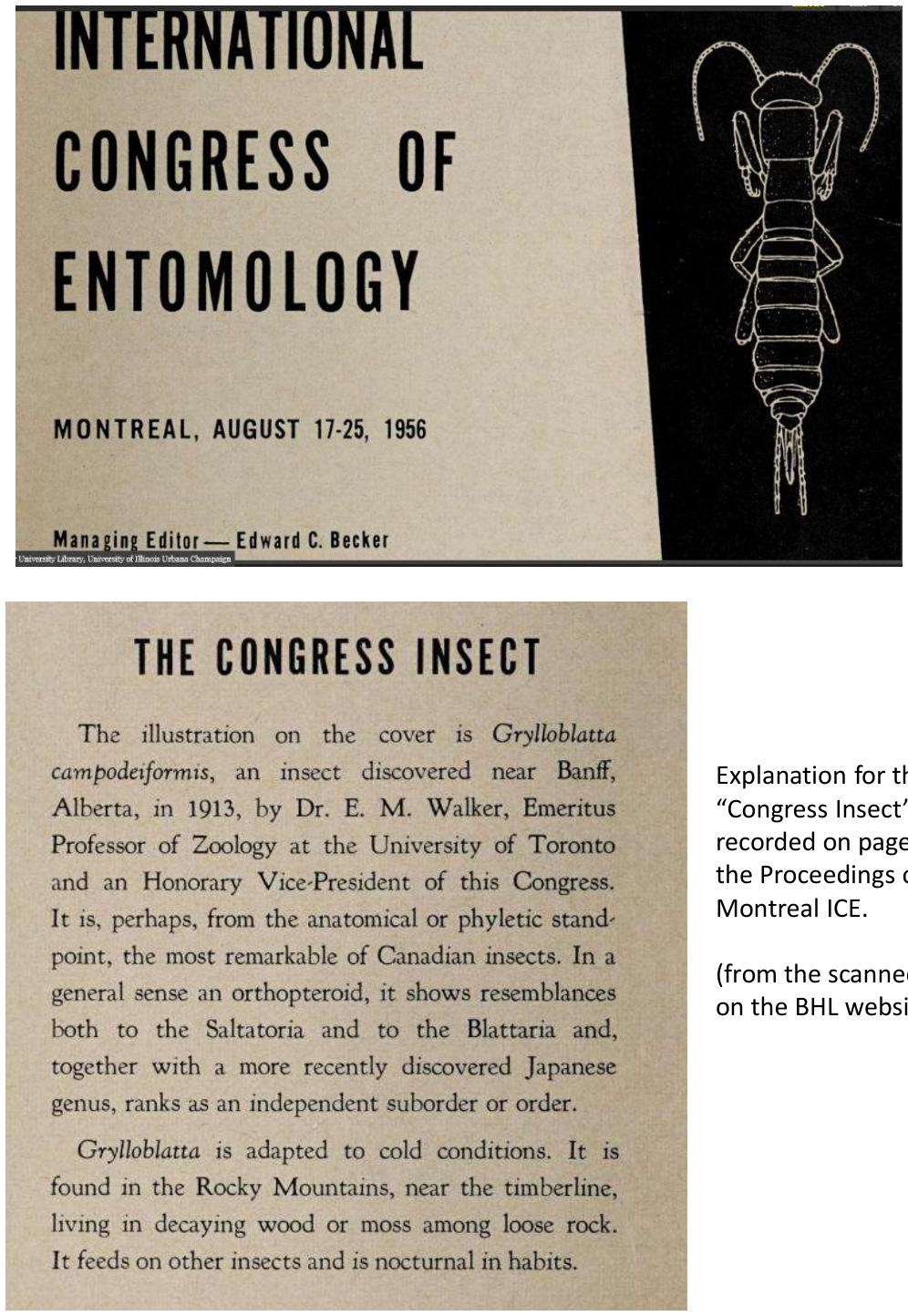
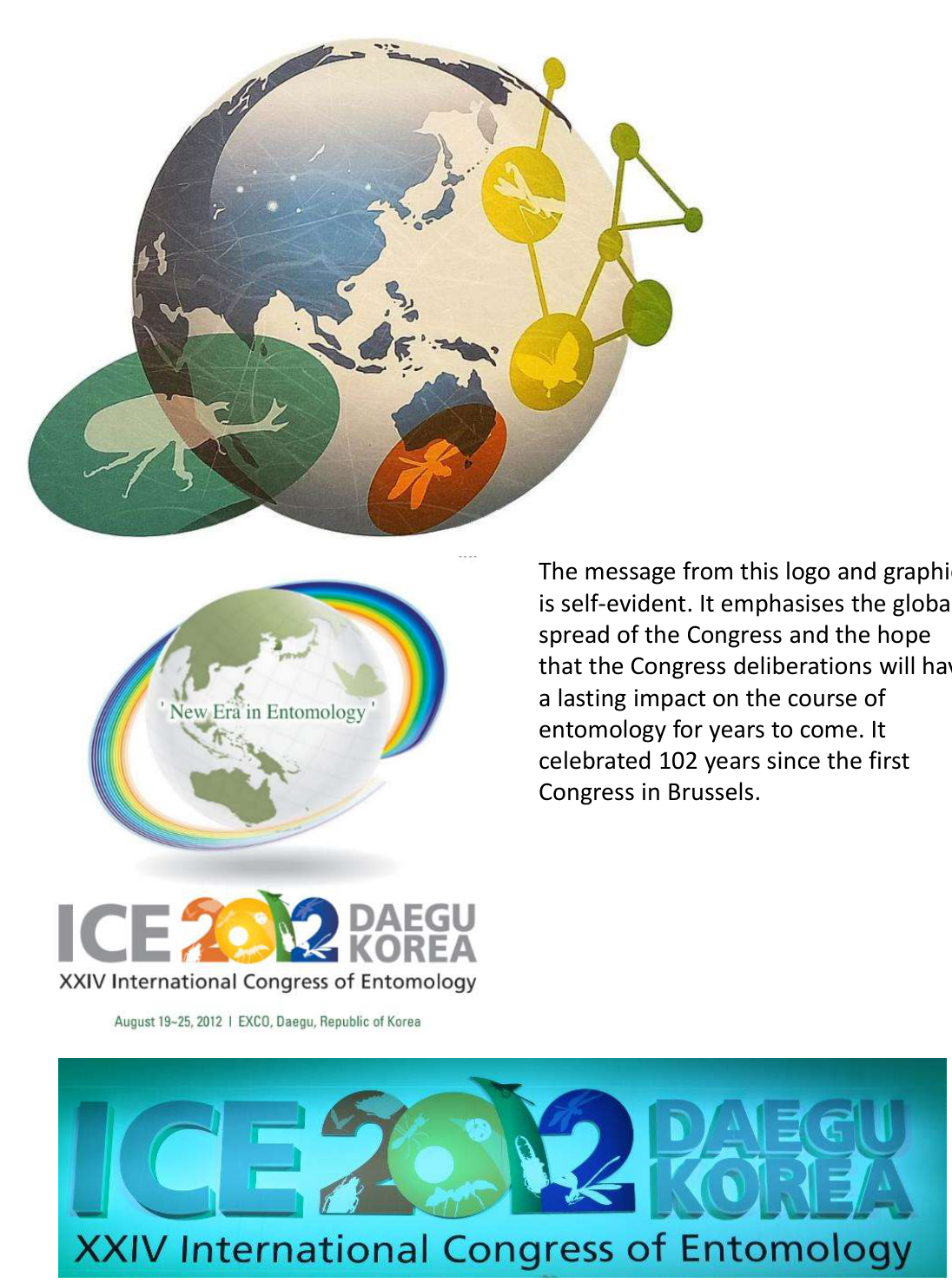
All ICEs produced a logo of some form. Early Congresses provided delegates with a metal badge. In some instances, the badge depicted the coat of arms for the city or institution where the Congress was held; e.g., Oxford University (1912), Paris (1932), Madrid (1935) and Vienna (1960). A number expressed, in some form, an entomological message or theme that the Organisers wished to emphasise. This could range from a popular insect, eg a butterfly for Berlin (1938), Amsterdam (1951) and Helsinki (2021); a dragonfly Kyoto (1980), ants Canberra (1972) and Brisbane (2004); an insect of great taxonomic interest Montreal (1955), London (1964) and Durban (2008); stylised insects emphasising culture or industry Moscow (1968), Hamburg (1984), Vancouver (1988), Beijing (1992) and Florence (1996), globalisation Washington (1976), Brazil (2000), Daegu (2012) and Orlando (2016). Stockholm (1948) uniquely featured a bust of countryman, Linnaeus. A number of recent ICEs included a motto which indicated some theme, e.g., Beijing (Living with Insects), Iguacu(Entomologists Preserving Biodiversity), Brisbane (Strength in Diversity), Daegu (New Era in Entomology), Orlando (Entomology without Borders) and Helsinki (Entomology for our Planet).
PS Ironically, neither the Council for ICEs, nor its preceding Executive Council and Permanent Committee, from what we can determine, can boast a logo or motto. Invariably, letters from the Council Executive were on the letterhead of the host institution (eg Thring Museum, The British Museum and the CSIRO Division of Entomology, etc). For a period (1999 -2004), Council’s letterhead was simply as follows:
Lack of a suitable dedicated Council logo is a deficiency that Council can well address, rather than drawing on a current ICE logo!
1910 · Brussels
Brussels ICE 1910
Delegates can be seen wearing Congress badges in the official group photo in the ICE Proceedings of this inaugural International Congress of Entomology. After many failed attempts, the elusive badge for the 1910 Brussels ICE was tracked down to the Science Museum, London. Thanks to Paul Wellings (9 January 2022). See next slide.
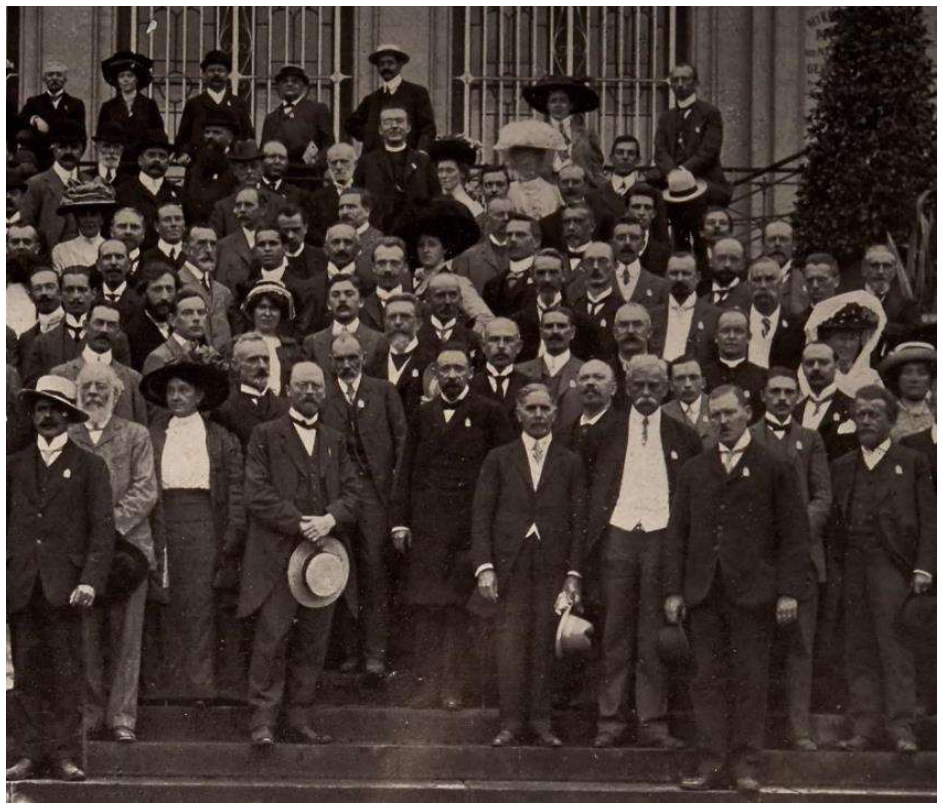
Photo extract from the Proceedings for 1910 Brussels ICE. These Proceedings can be freely accessed, along with copies of the Proceedings for most ICEs, on the website of the Biodiversity Heritage Library (BHL): https://www.biodiversitylibrary.org/bibliography/156584#/summary.
Scanning the Proceedings of ICEs is a ‘work in progress’. Entomologists and other scholars are indebted to the Smithsonian Institute for championing the free and ready electronic access to these valuable resource’s via the virtual BHL.
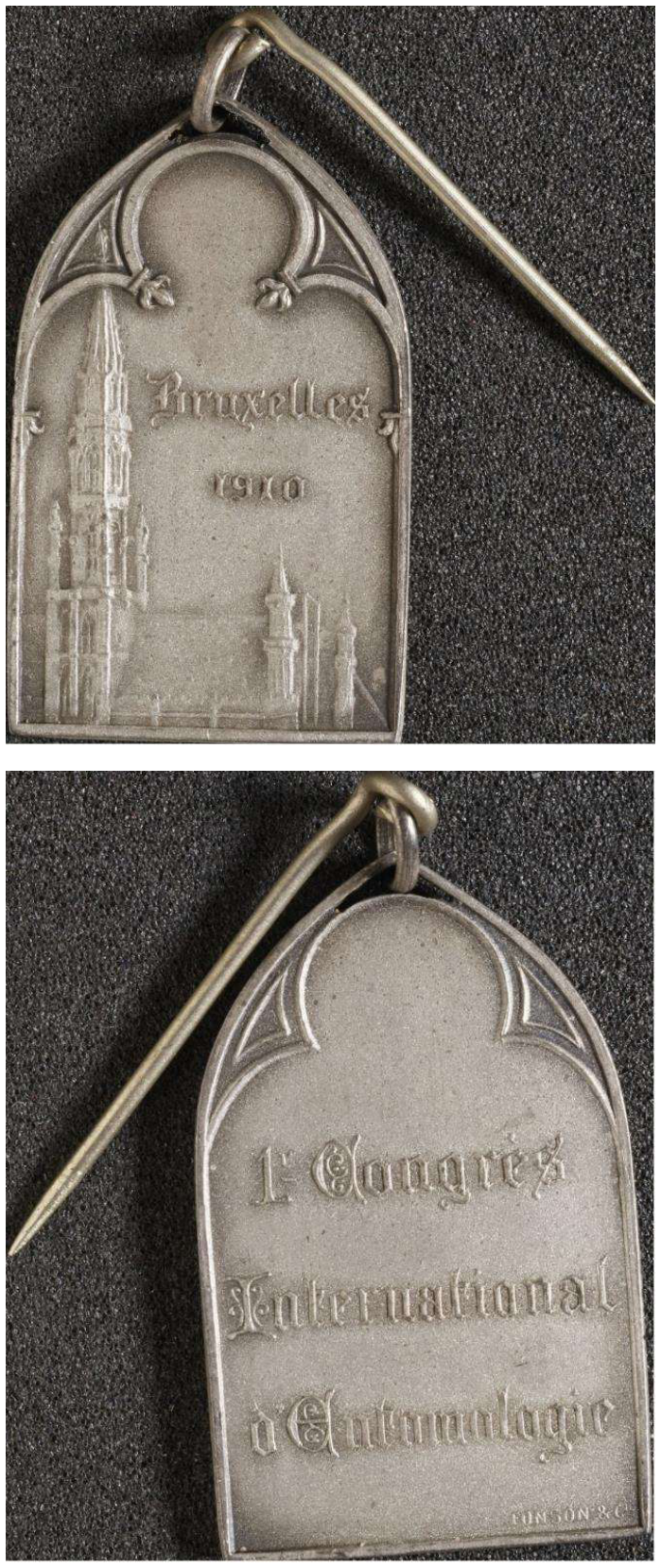
Item A670851 in the Science Museum, London.
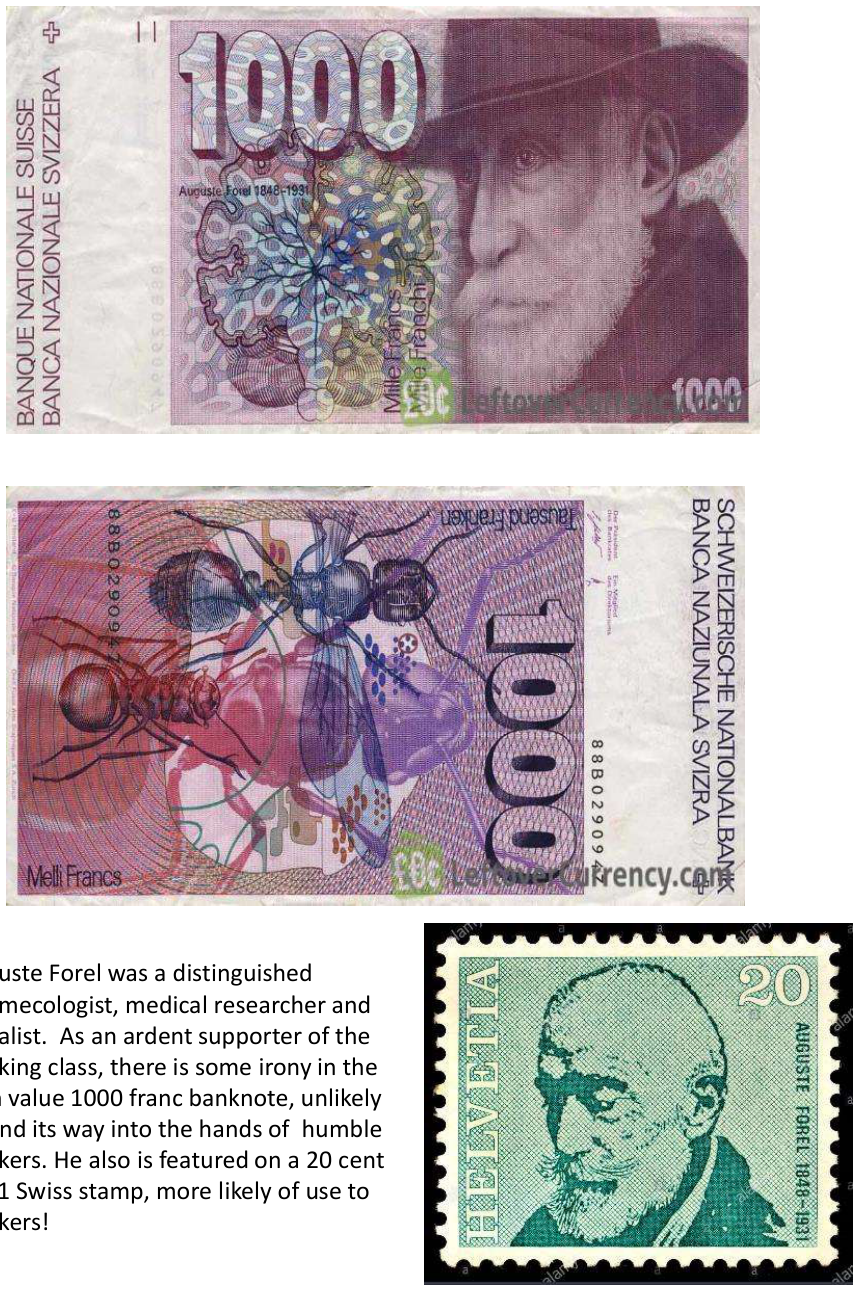
We note the posthumous recognition of one prominent and active delegate at Brussels, namely Auguste Forel (1848-1931). Forel also attended the 1925 Zurich ICE and was an Honorary Member of ICEs. Forel is the only known entomologist to feature on a major currency, namely the Swiss Franc (in circulation 1978-2000).
1912 · Oxford
Delegates badge for the 1912 Oxford 2nd ICE
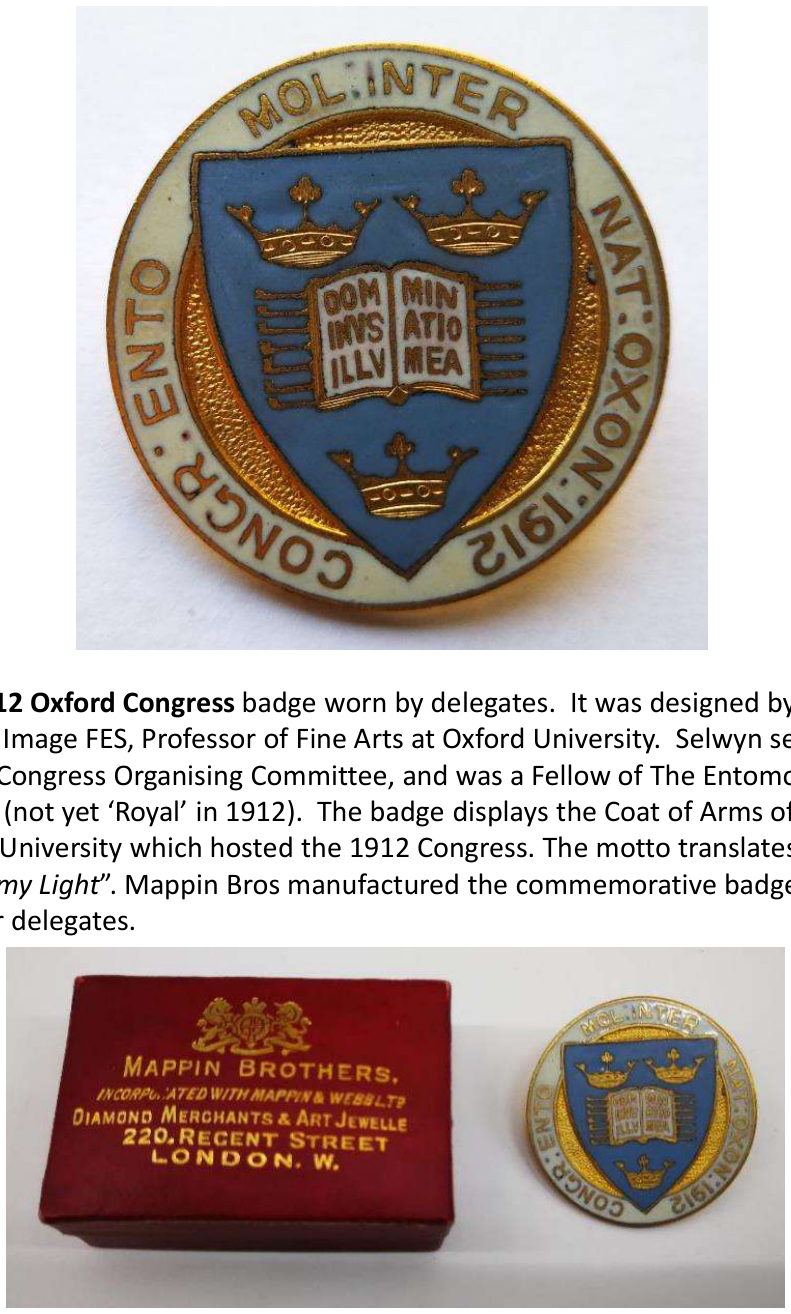
[Images provided by Royal Entomological Society, courtesy Librarian, Val McATear, on behalf of The Trustees. © The Trustees of the Natural History Museum, London. All Rights Reserved.” (Collection item reference TM/1/152).]
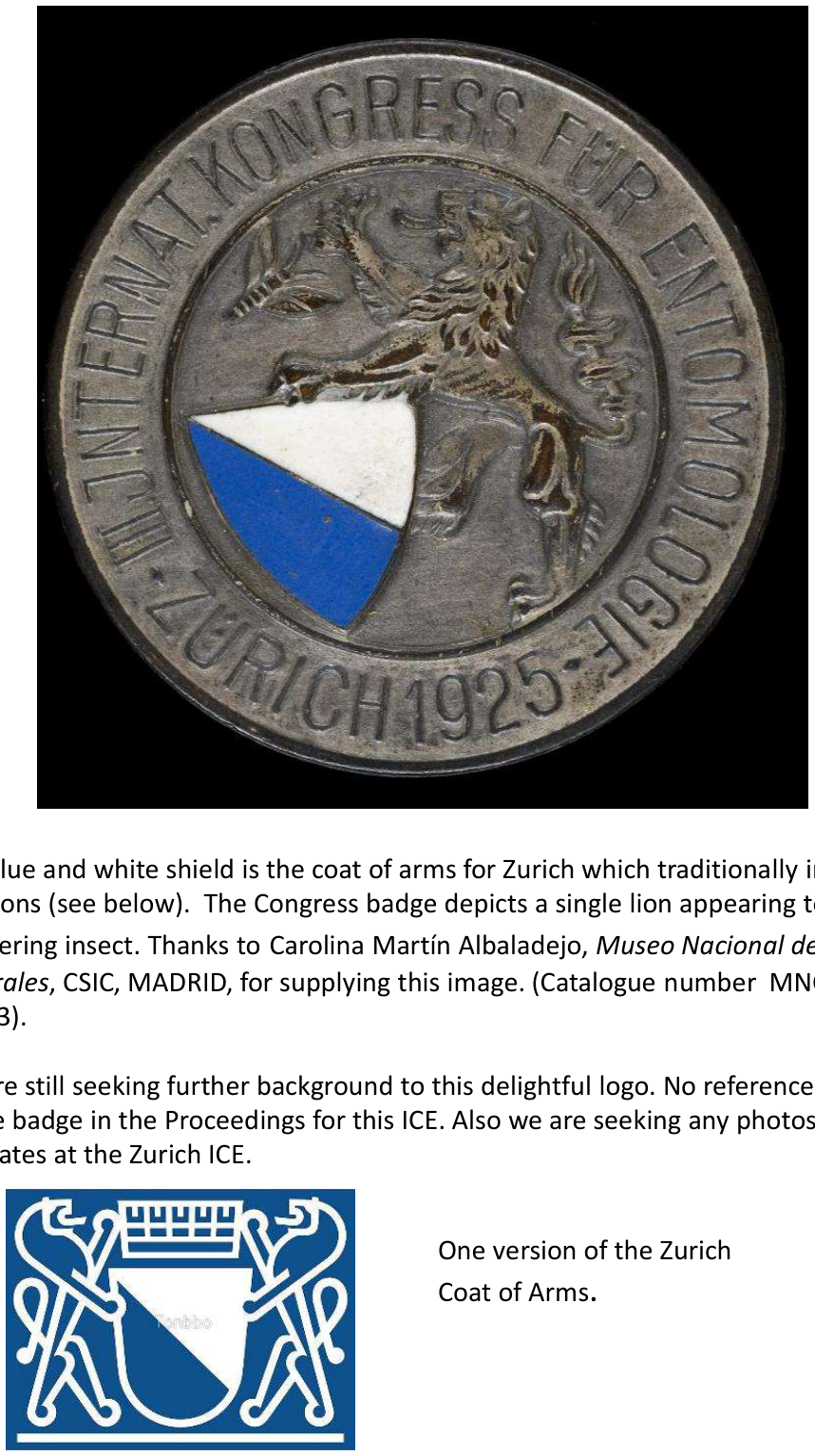
1925 · Zurich
Delegates badge for 1925 Zurich 3rd ICE
1928 · Ithaca
Delegate’s badge for 1928 Ithaca 4th ICE
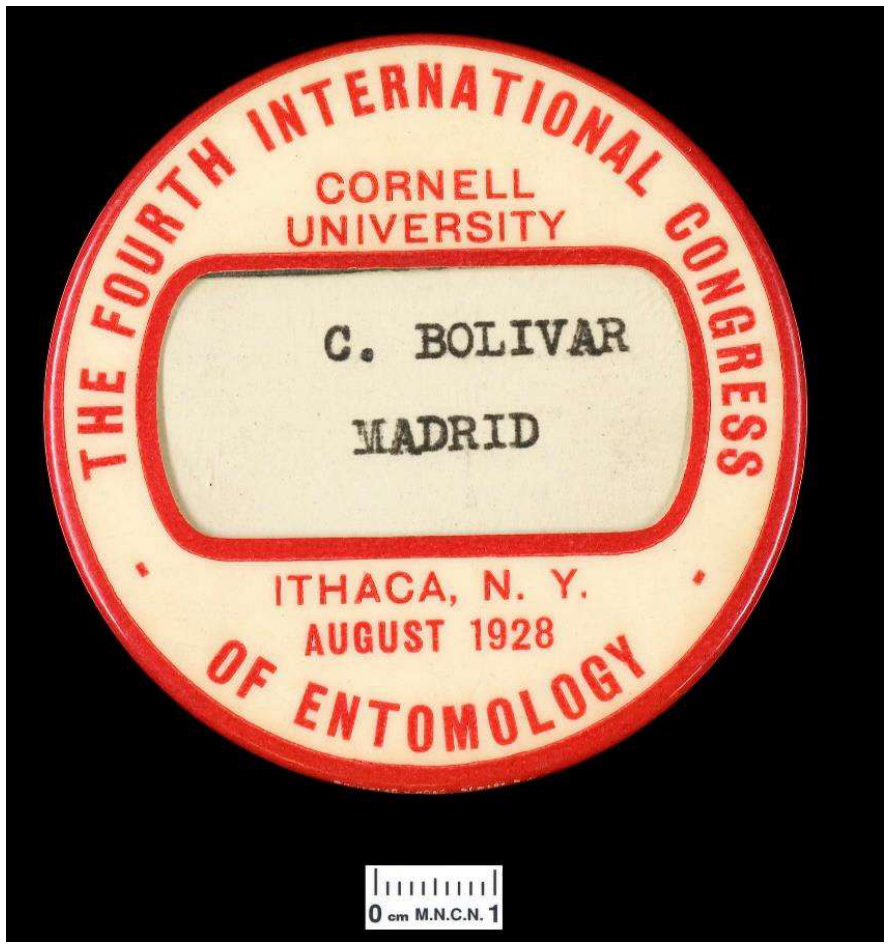
This ‘matter of fact’ badge was worn by Dr Candido Bolivar y Pieltain who was one of the official Spanish Delegates at the 1928 Ithaca ICE; and subsequently served as Secretary for the 1935 Madrid ICE.
Thanks to Carolina Martín Albaladejo, Museo Nacional de Ciencias Naturales, CSIC, MADRID, for supplying this image. (Catalogue number MNCN-BA005).
1932 · Paris
Logo for 1932 Paris 5th ICE
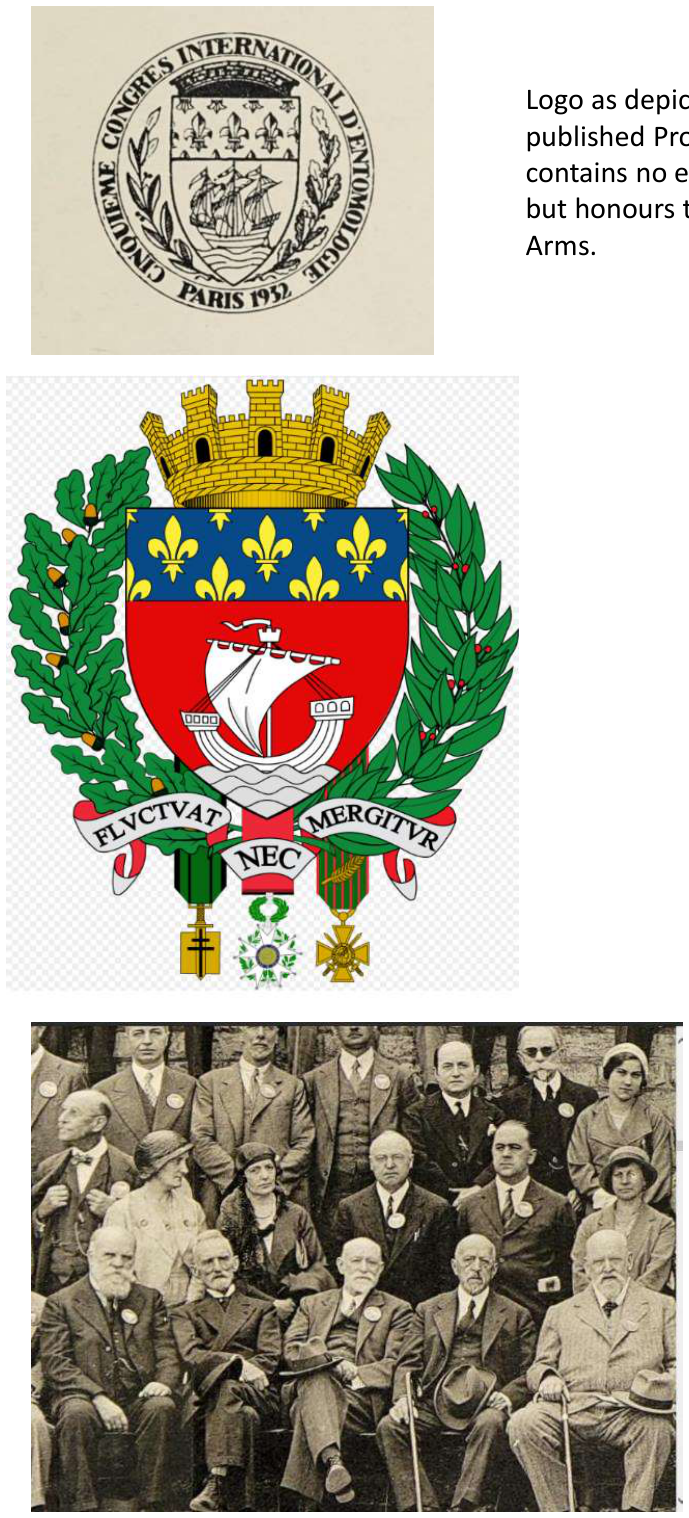
Coat of Arms for City of Paris: Fluctuat nec mergitur (“She is tossed by the waves, but does not sink”)
Selection of delegates at the 1925 Paris ICE displaying the large Congress badge. Karl Jordan is seated front row left and Lord Walter Rothchild front row right.
Delegates Badge for 1932 Paris 5th ICE
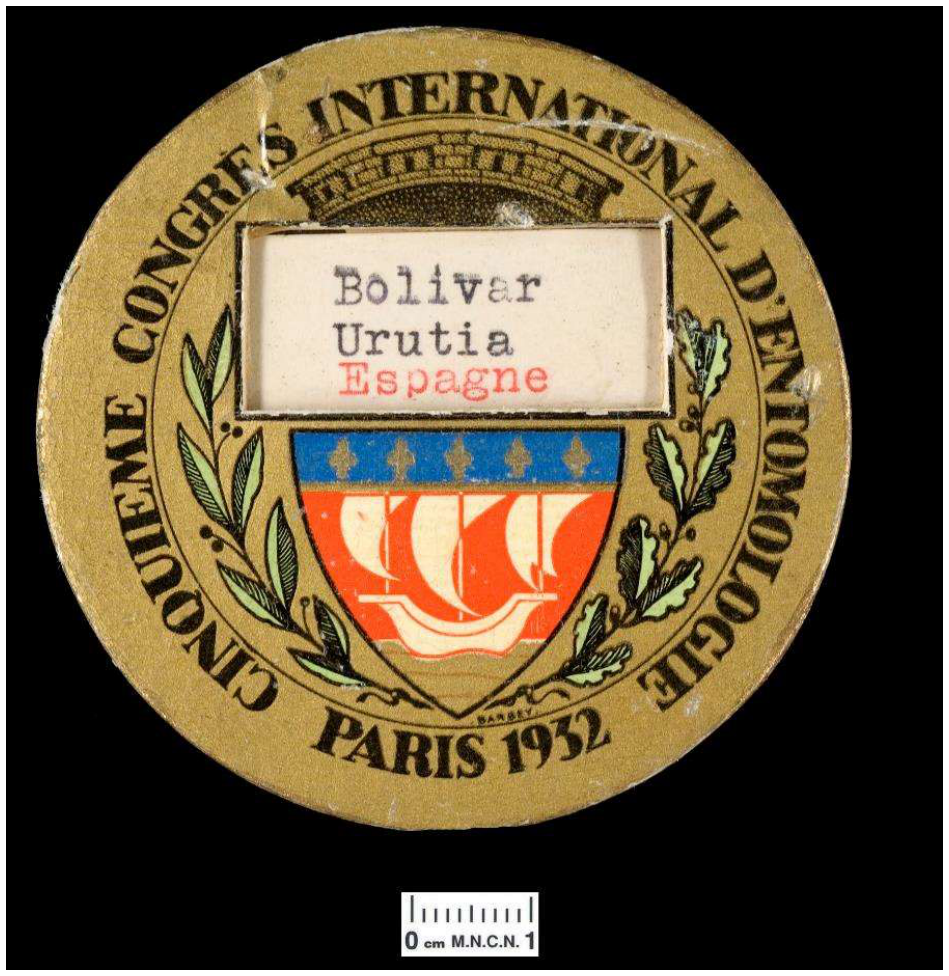
Delegate’s badge for Ignacio Bolivar Urutria who later served as President for the 1935 Madrid ICE. Thanks to Carolina Martín Albaladejo, Museo Nacional de Ciencias Naturales, CSIC, MADRID, for supplying this image. (Catalog number of ICE Paris badge MNCN-BA010).
1935 · Madrid
Delegates Badge for 1935 6th Madrid ICE
1938 · Berlin
Logo for 1938 7th Berlin ICE
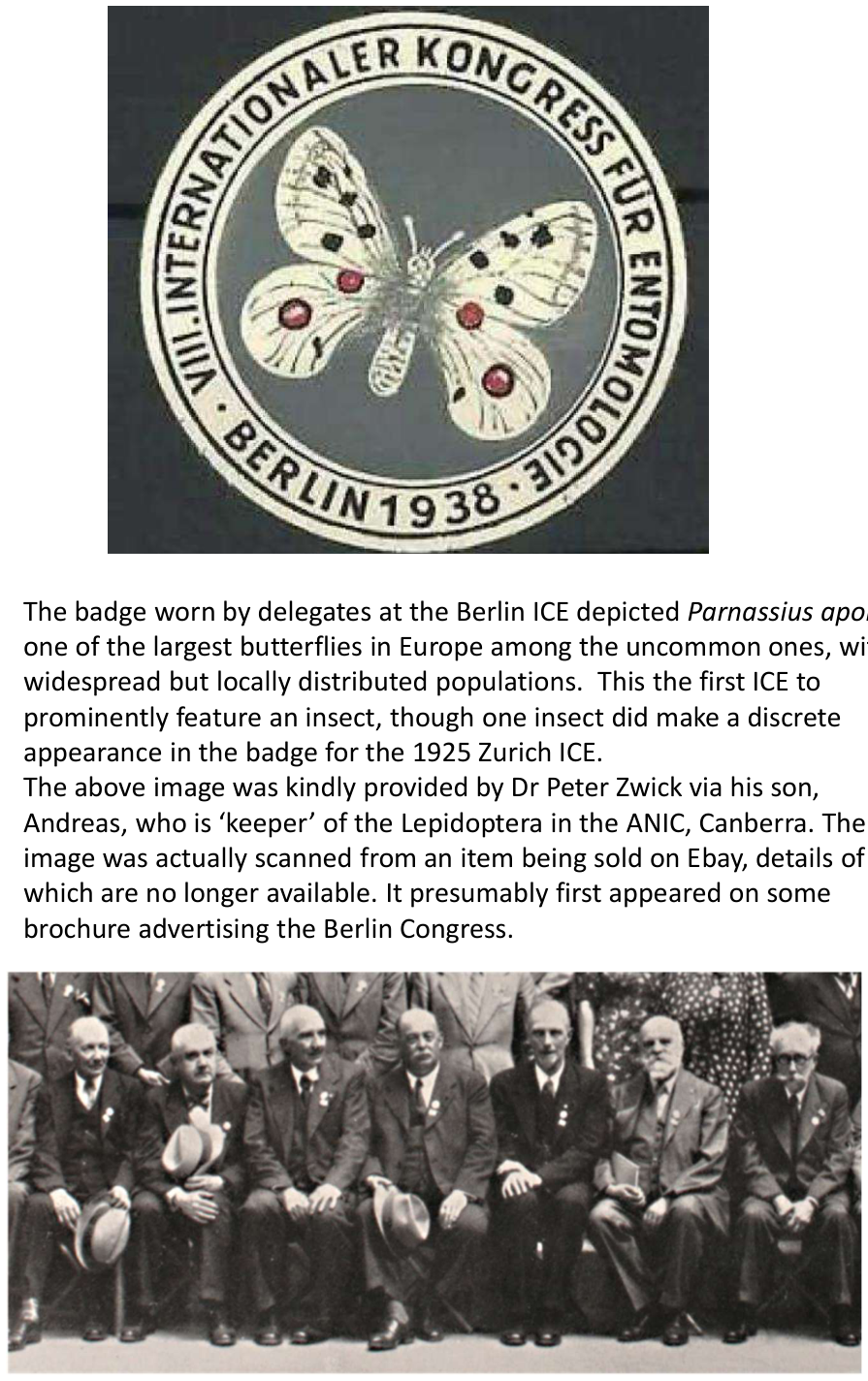
Selection of prominent delegates at the 1938 Berlin ICE displaying official badges. We have yet to sight an actual badge in any detail for this Congress.
Logo for 1938 Berlin 7th ICE (cont’d)
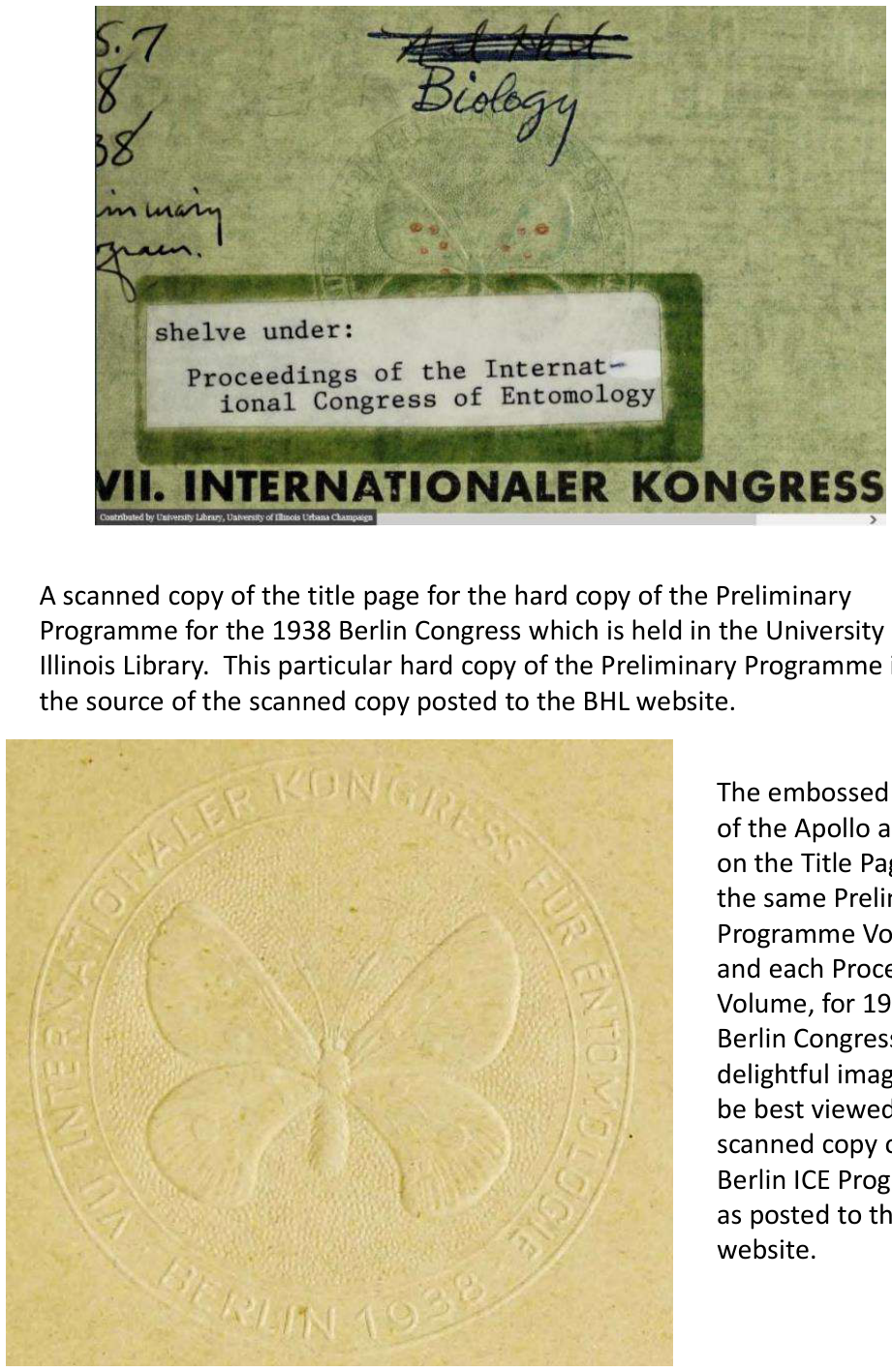
Logo for 1938 Berlin 7th ICE (cont’d)
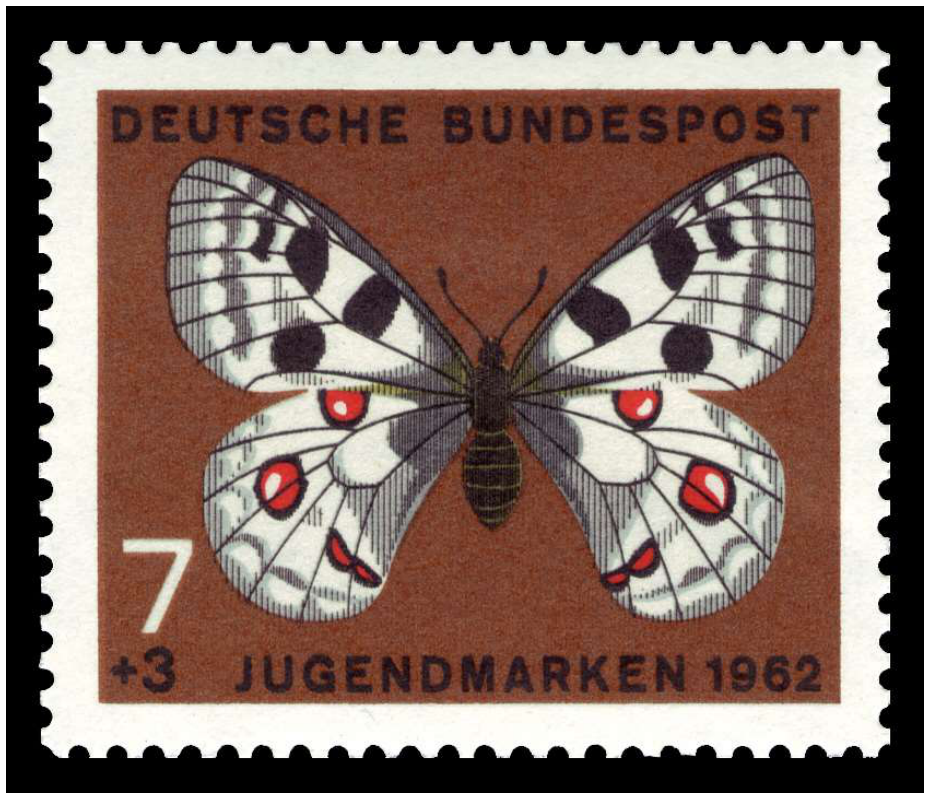
Unfortunately, this stamp of the Apollo butterfly was issued in Germany in 1962, and is not connected to the 1938 Berlin ICE.
The butterfly appears on numerous other stamps. However, it has a very interesting biology; hence its inclusion to provide some appreciation for its choice to grace a Congress logo. Surprisingly, a search for Parnassius apollo in all the Volumes of the Berlin Congress in the BHL, failed to highlight the logo or why this insect was chosen. (Maybe some German entomologist can chase up records that might still be archived in the Entomological Societies involved in managing the Congress to provide further background.)
1948 · Stockholm
Logo for 1948 Stockholm 8th ICE
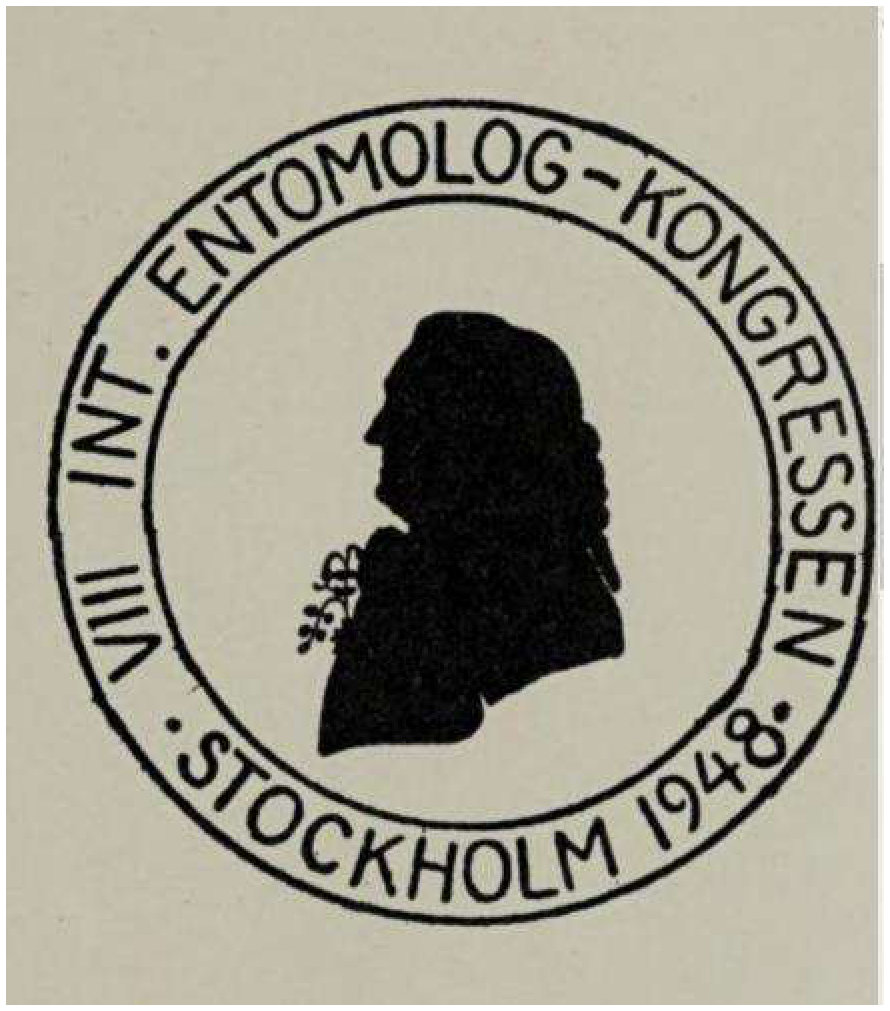
The logo for this ICE depicts a bust of Linnaeus. An official visit to his country estate was a highlight of the Stockholm Congress.
A Bus Excursion to Linnaeus’ home, “Linnes Hammarby” took place on Wed 11 August 1948 during Stockholm ICE. See next slide for more detail of the excursion.
Logo for 1948 Stockholm 8th ICE
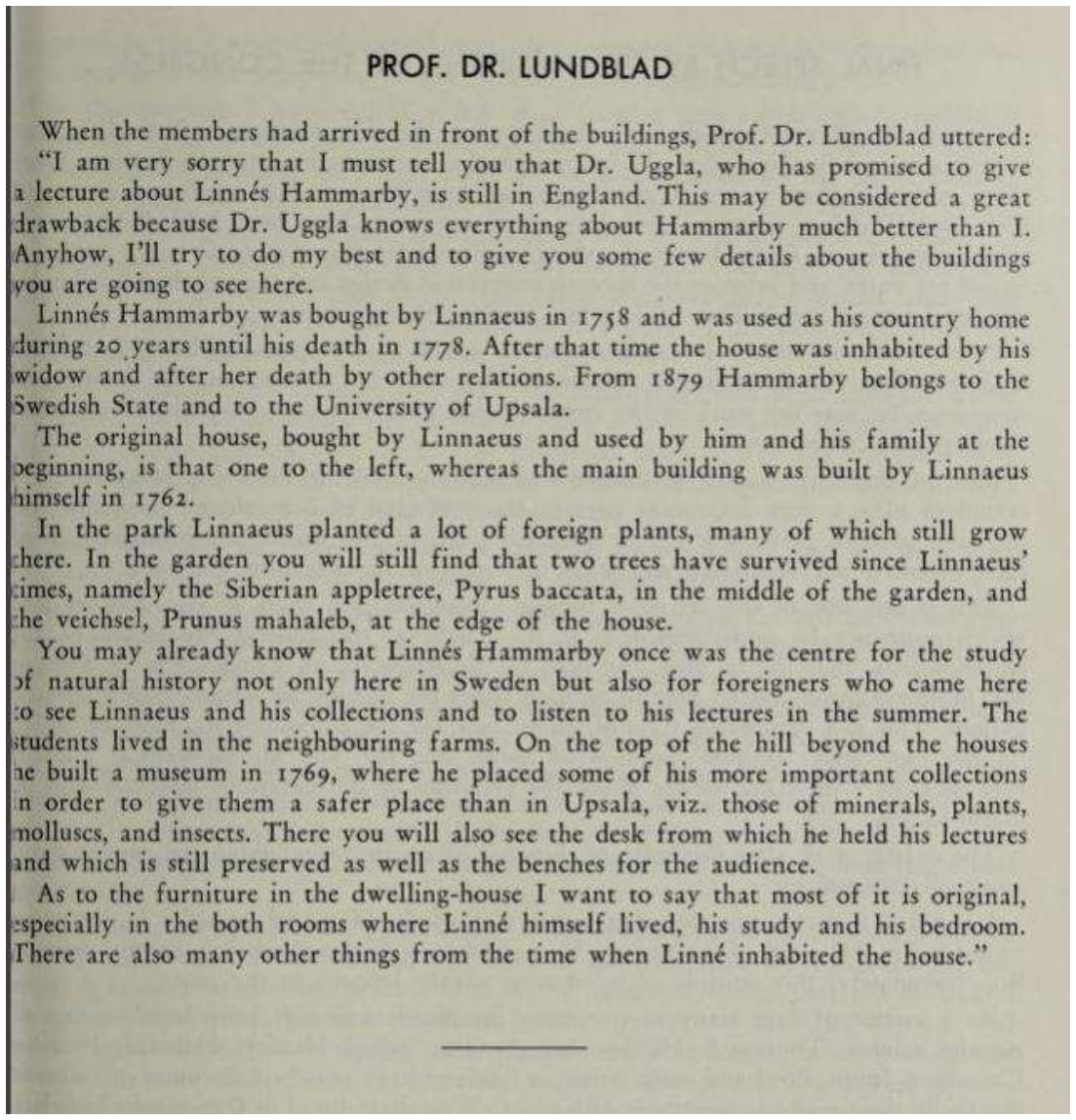
Extract from the Proceedings of the 1948 Stockholm ICE, page 49.
1951 · Amsterdam
Logo for the 1951 Amsterdam 9th ICE
This appears to be the first ICE with a logo employing entomological symbolism; and which featured prominently on the registration badge of delegates. Like previous ICEs there was no explicit theme for this ICE.
1958 · Montreal
Logo for 1955 10th ICE Montreal
1960 · Vienna
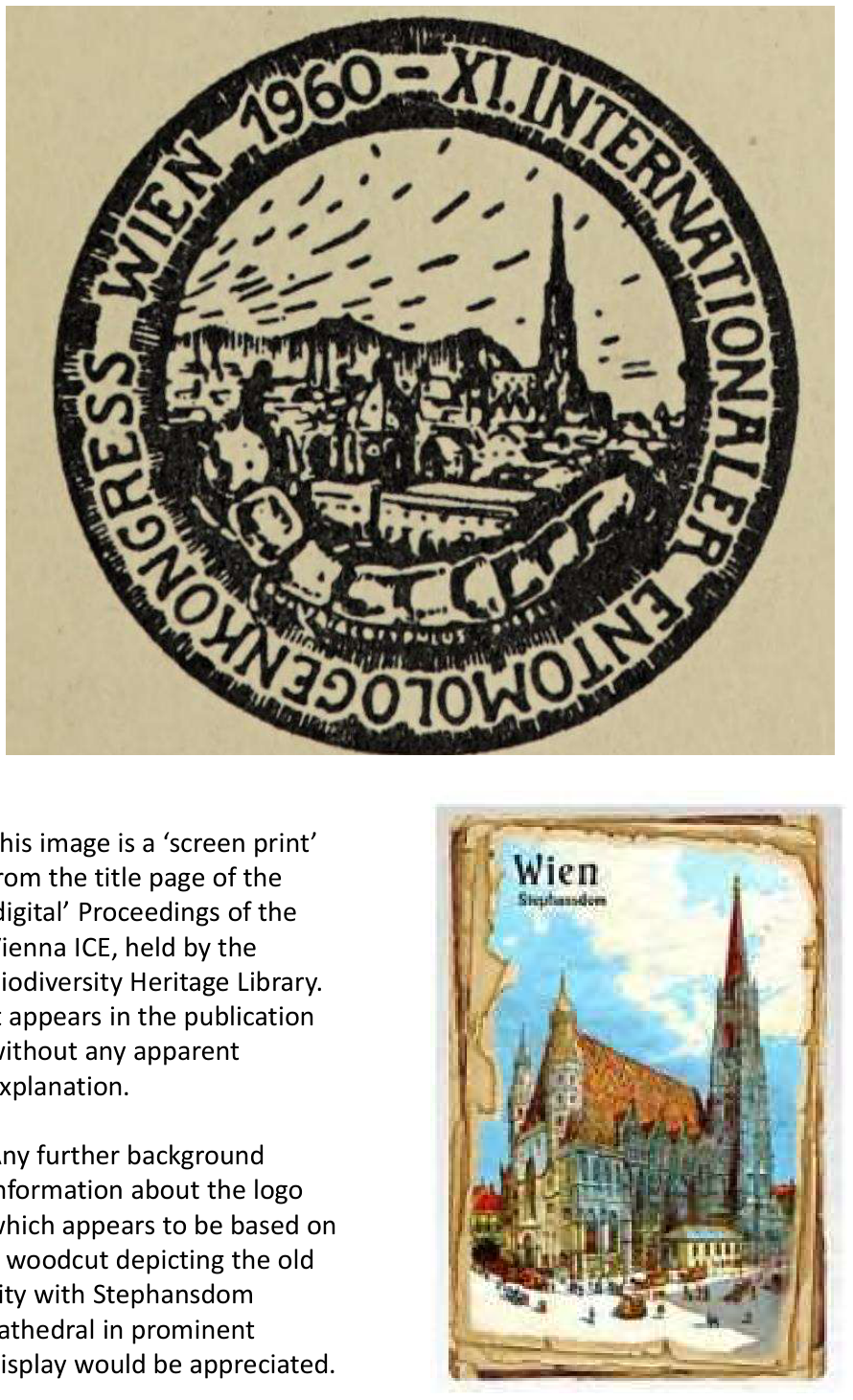
Logo for the 1960 Vienna 11th ICE
1964 · London
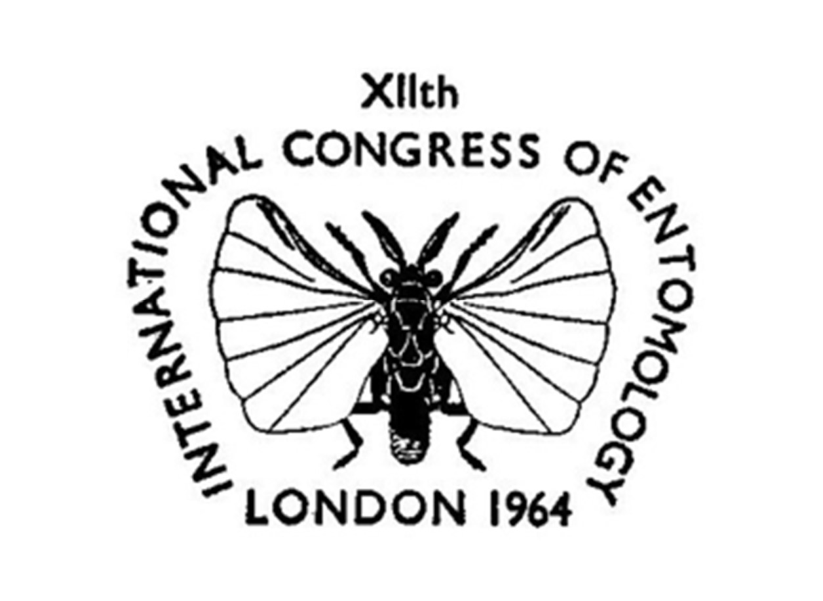
“By the end of 1961 the Congress crest had been designed and
incorporated a male Stylops because of the association with the Reverend
William Kirby who founded the order Strepsiptera in 1811 and who was
elected as the first Honorary Life President of the RES at its formation in
1833. The RES seal and logo also include a male Stylops. Stylops, twisted-
wing insects, are obligate parasites of bees and wasps or planthoppers.
Males have a free-living adult stage but females retain a specialized grub-
like form and live their entire life within the host. Mating occurs when the
female head/thorax is pushed through the host cuticle, pheromones are
released and males locate and mate. The eggs hatch inside the mother
and triungulin larvae emerge to settle on flowers. When a suitable host
arrives, the larvae penetrate through the cuticle and development
continues through larval and pupal stages.”
(Extract from Chapter 4 “History of International Congresses of
Entomology” authored by Jim Hardie) (in press):
1968 · Moscow
Logo for 1968 Moscow 13th ICE
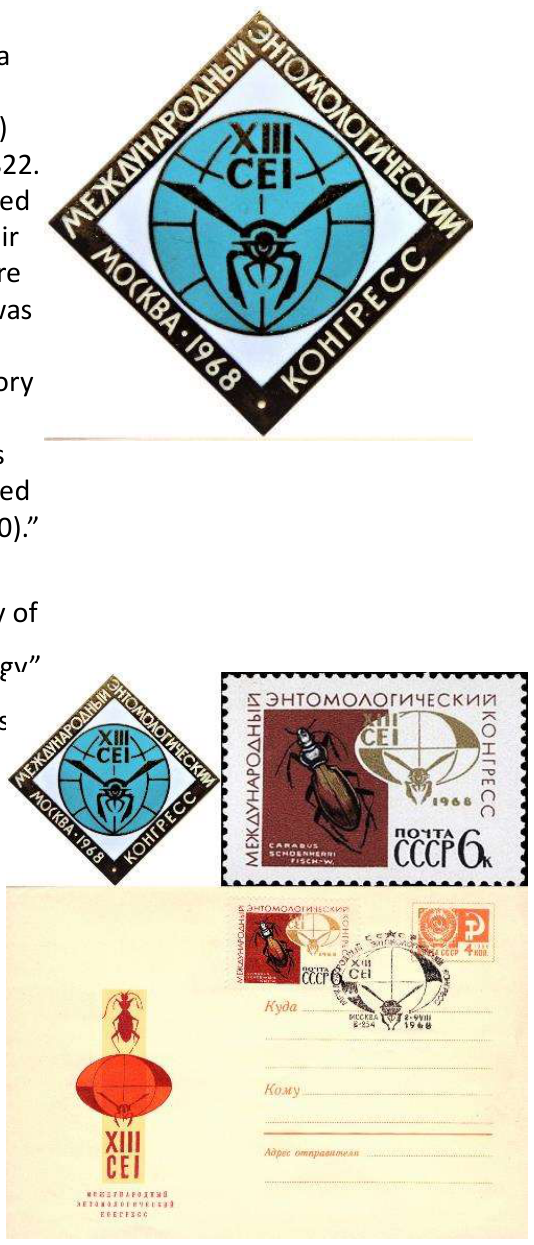
This appears to be the first ICE honoured with a special stamp issue.
1972 · Canberra
Logo for 1972 14th Canberra ICE Canberra
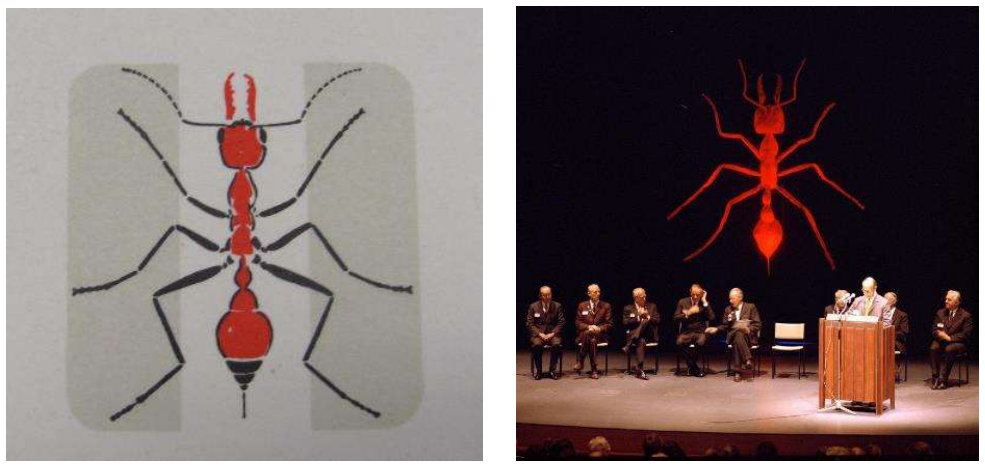
“European explorers visiting Australia since 1770 collected the new insects they saw and took them back to Europe to be named. The insect selected to be the Congress logo by the Local Organizing Committee was Myrmecia gulosa (Fabricius 1775), the red bulldog ant. It is an endemic Australian species and was one of 212 Australian insect species collected by Joseph Banks and Daniel Solander on James Cook’s expedition in 1770, described in 1775 by Fabricius in Systema Entomologiae (Waterhouse 1971). The original specimen collected by Joseph Banks and Daniel Solander in 1770 is still in good condition and held in the Banks collection at the Natural History Museum in London. A giant model of this species was made as backdrop for the opening and closing ceremonies in Canberra. An exhibit titled ‘Insects and Man’, prepared by CSIRO for the National Library of Australia, included a live colony of bulldog ants, and proved popular with the general public. The bulldog ant had earlier been selected as the logo of the Australian Entomological Society. “
Extract from Chapter 6, in “The History of International Congresses of Entomology” authored by James Ridsdill-Smith (in press)
1976 · Washington
Logo for 1976 Washington 15th ICE
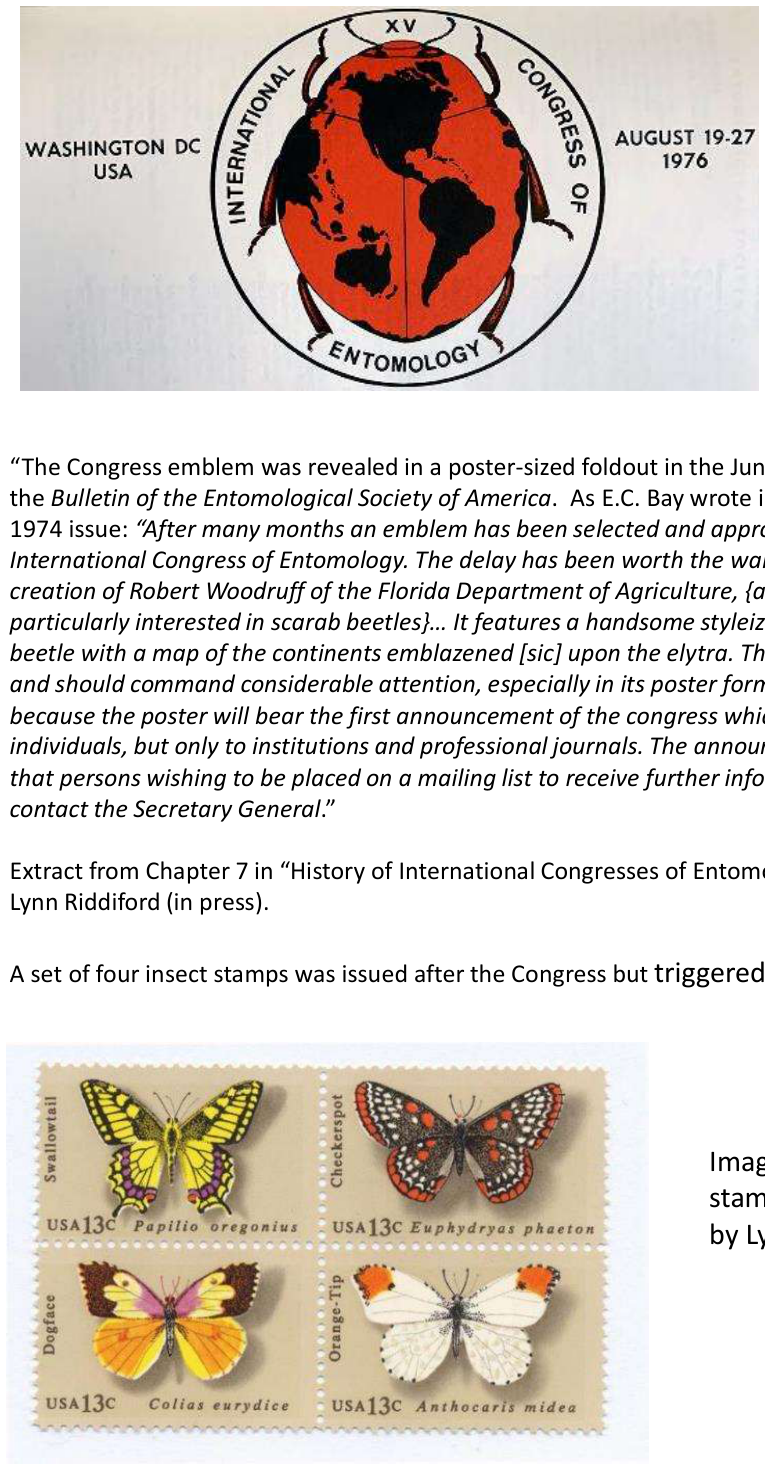
By 1976, the Congress logo had assumed significance as an advertising tool to encourage attendance at the Congress
1980 · Kyoto
Logo for the Kyoto 1980 16th ICE
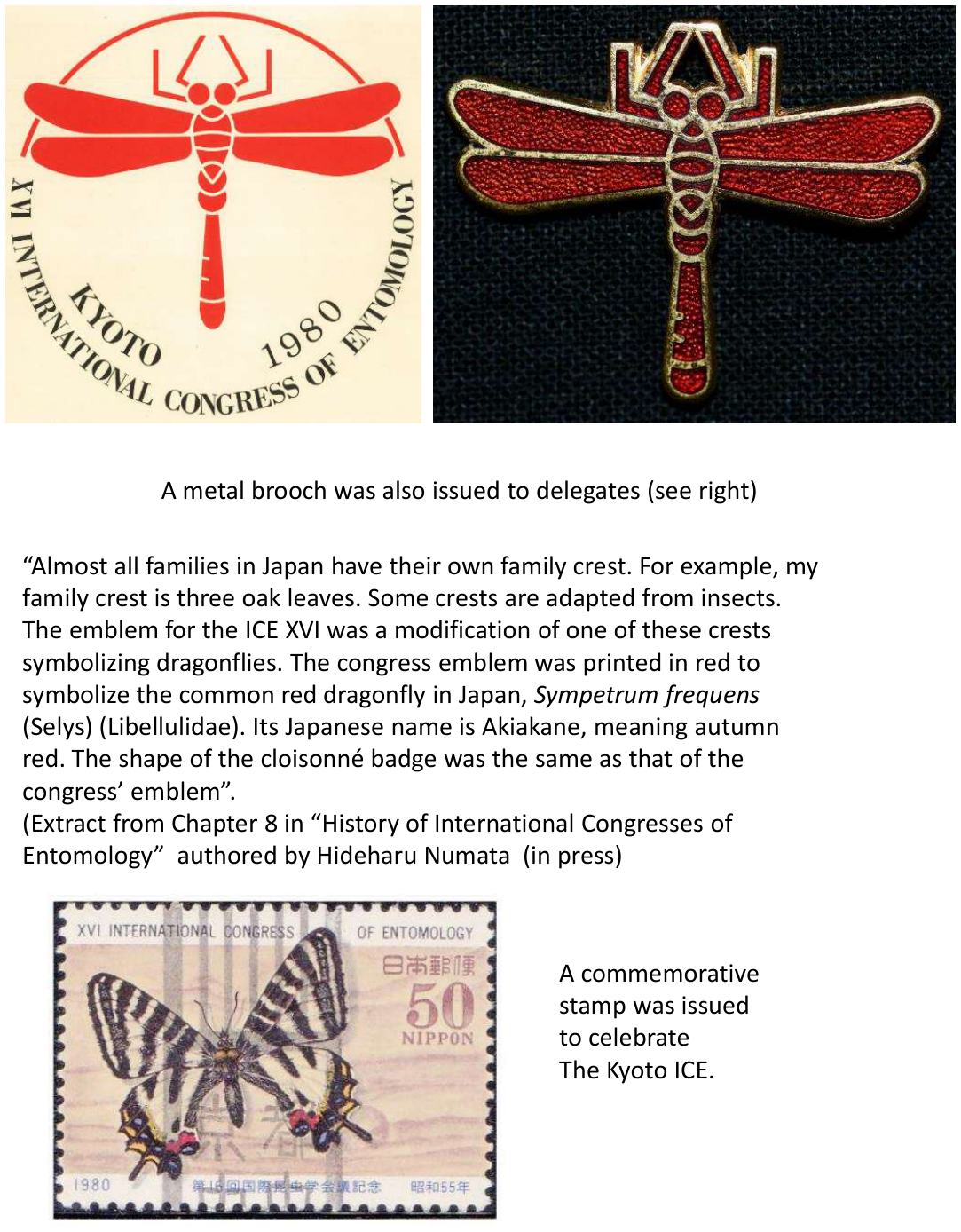
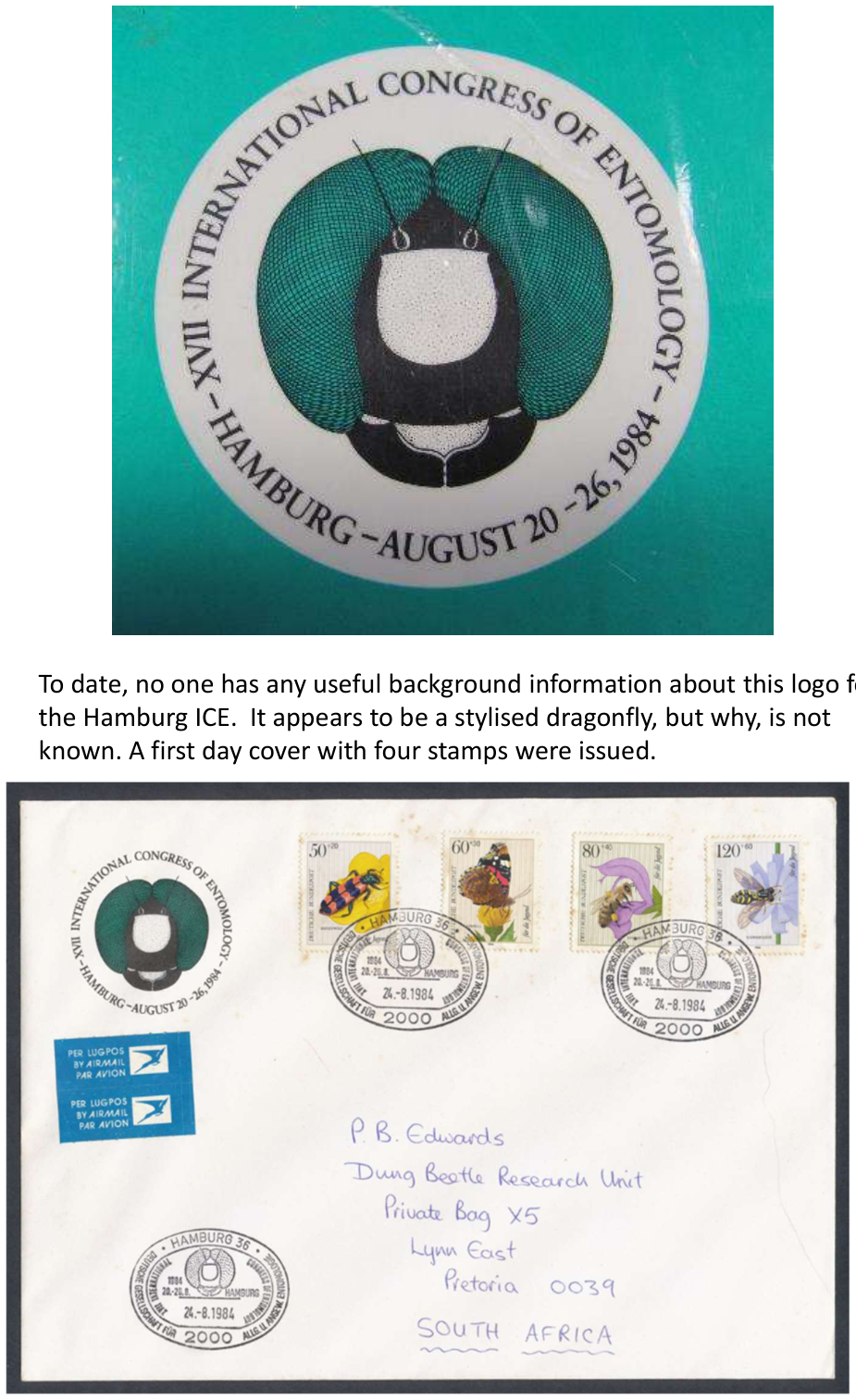
1984 · Hamburg
Logo for 1984 Hamburg 17th ICE
1988 · Vancouver
Logo for 1988 Vancouver 18th ICE

“With the help of the Royal British Columbia Museum (RBCM), a Congress logo was designed and developed by Richard Hunt, a well-known Kwakwaka’wakw (formerly referred to as Southern Kwakiutl) artist and carver, then the RBCM chief carver. The Congress Logo (Fig. 1) comprised 8 ladybird beetles arranged in the form of a flower to symbolize insect-plant relations, with the center of the flower depicted as a vertebrate face-form, which symbolized insect-vertebrate interactions. A red, white, and black version of this logo was used on most Congress products, commemorative emblems, and publications, while a black and white version was used on all official correspondence.”
Extract from Chapter 10 in “History of International Congresses of Entomology” authored by Geoffrey G.E. Scudder and Charles (in press)
Logo for 1988 Vancouver 18th ICE (cont’d)
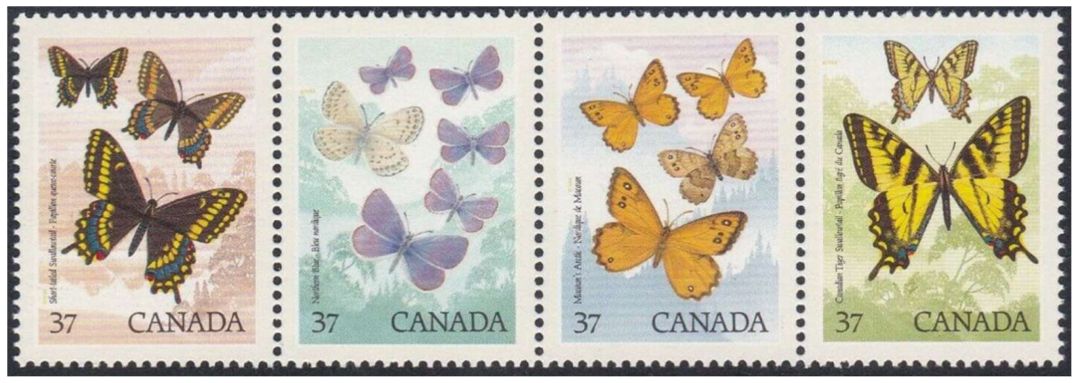
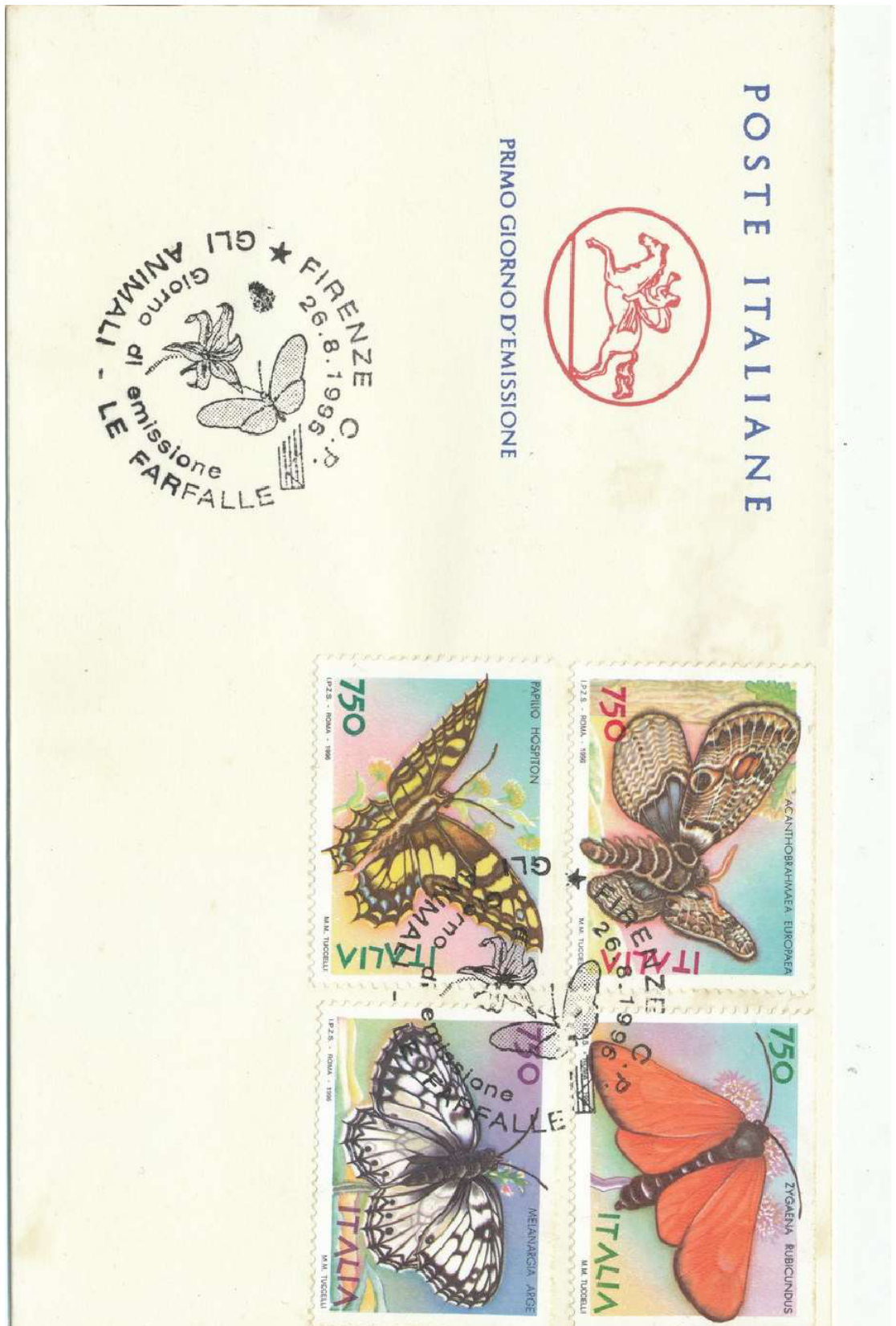
Vancouver: “The ESC convinced Canada Post to issue a special stamp series to
commemorate the Congress and to attend the Congress at their expense. The Lepidopterist
Don Lafontaine suggested four Canadian species. The stamps featured (from left to right): the
Canadian Tiger Swallowtail (Papilio canadensis) is one of the most showy and familiar species
in Canada and is found from coast to coast. The Northern Blue (Lycaeides idas) is found across
boreal and subarctic Canada. The beautiful iridescent blue of the upper wing and metallic blue
and orange spots below give the species a winged jewel appearance. Macoun’s Arctic butterfly
(Oeneis macounii) was named after the famous Canadian naturalist, John Macoun, and occurs
in the boreal forest zone across central Canada from Quebec westward. The Short-tailed
Swallowtail (Papilio brevicauda) is the only species of butterfly whose range is entirely
restricted to Canada. lt occurs only in the Maritime provinces and eastern Quebec.”
Extract from Chapter 10 in “History of International Congresses of Entomology” authored by Geoffrey G.E. Scudder and Charles (in press)
Logo for 1988 Vancouver 18th ICE (cont’d)
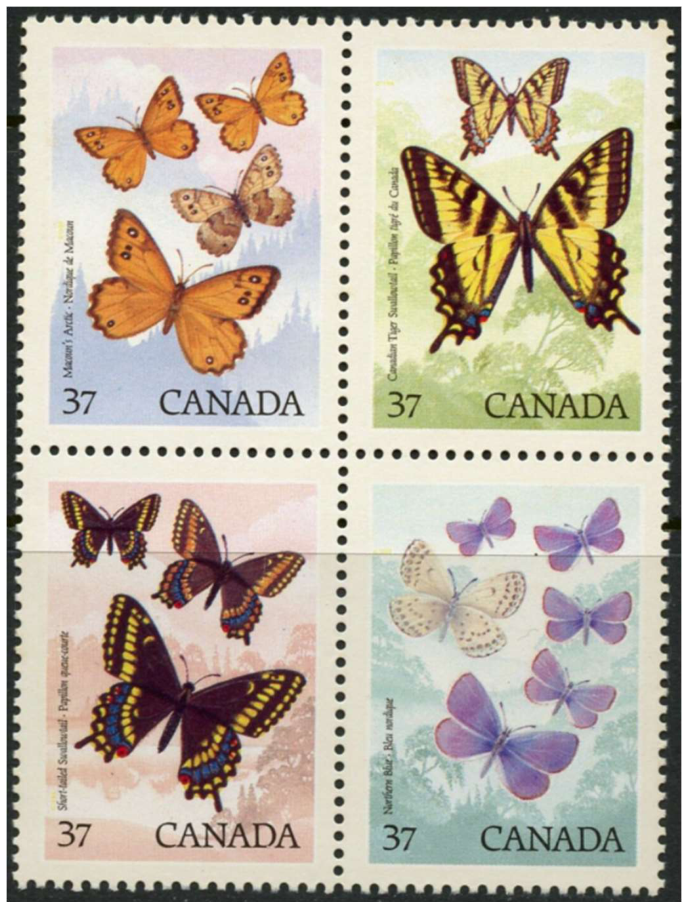
Vancouver: “The ESC convinced Canada Post to issue a special stamp series to
commemorate the Congress and to attend the Congress at their expense. The Lepidopterist
Don Lafontaine suggested four Canadian species. The stamps featured (from left to right): the
Canadian Tiger Swallowtail (Papilio canadensis) is one of the most showy and familiar species
in Canada and is found from coast to coast. The Northern Blue (Lycaeides idas) is found across
boreal and subarctic Canada. The beautiful iridescent blue of the upper wing and metallic blue
and orange spots below give the species a winged jewel appearance. Macoun’s Arctic butterfly
(Oeneis macounii) was named after the famous Canadian naturalist, John Macoun, and occurs
in the boreal forest zone across central Canada from Quebec westward. The Short-tailed
Swallowtail (Papilio brevicauda) is the only species of butterfly whose range is entirely
restricted to Canada. lt occurs only in the Maritime provinces and eastern Quebec.”
Extract from Chapter 10 in “History of International Congresses of Entomology” authored by Geoffrey G.E. Scudder and Charles (in press)
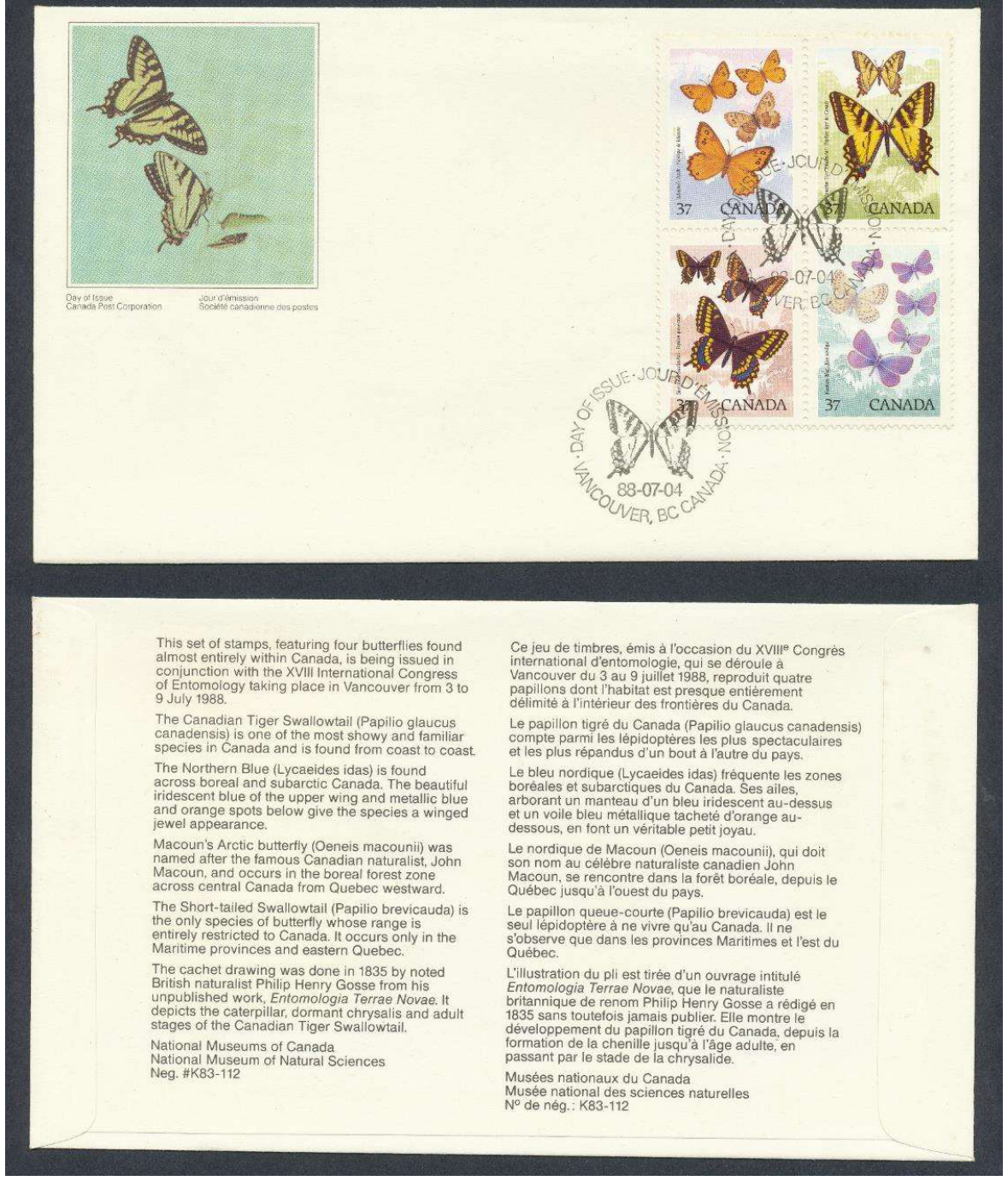
First Day Cover, XVIII ICE, Vancouver. Image kindly provided by Charles Vincent.
1992 · Beijing
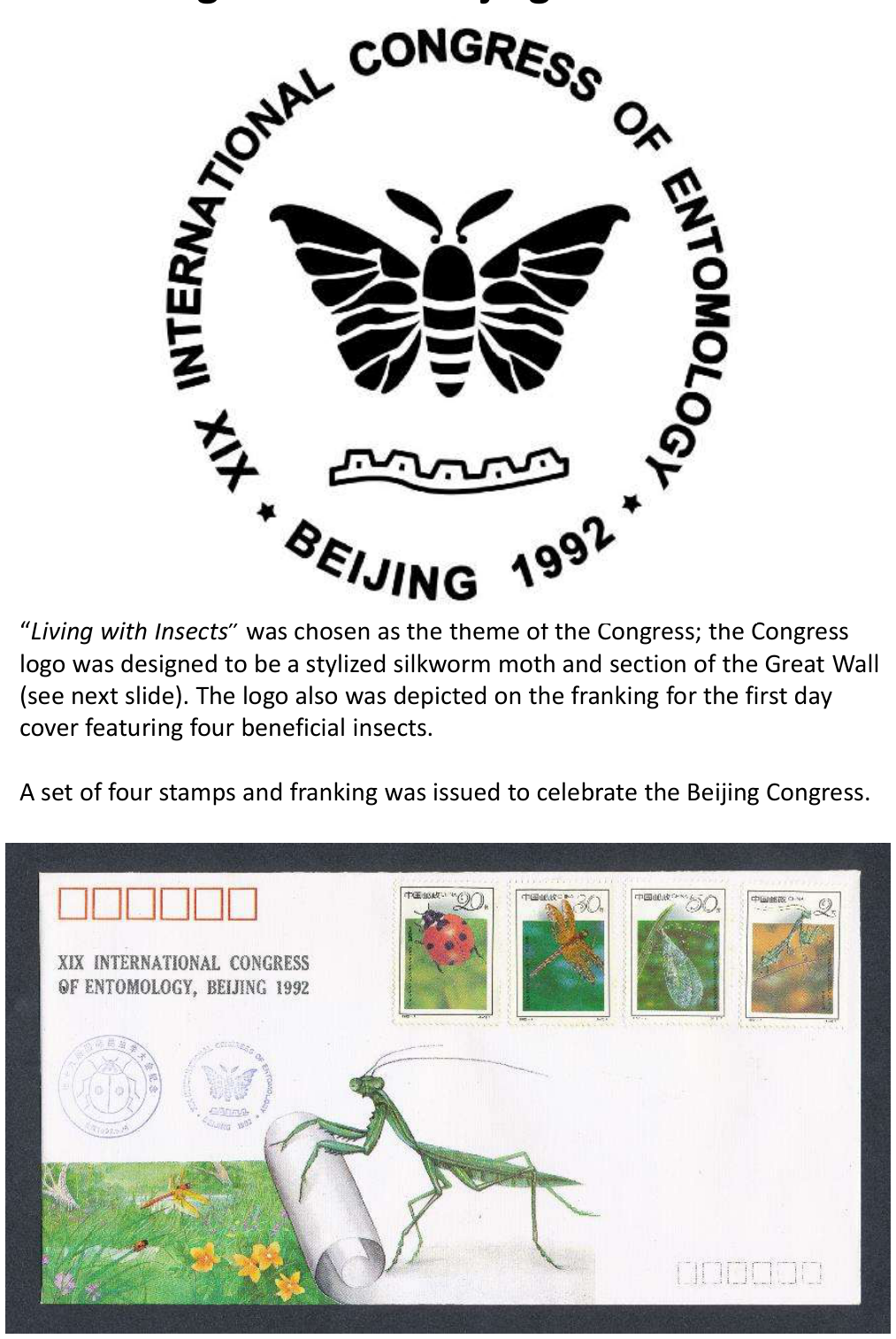
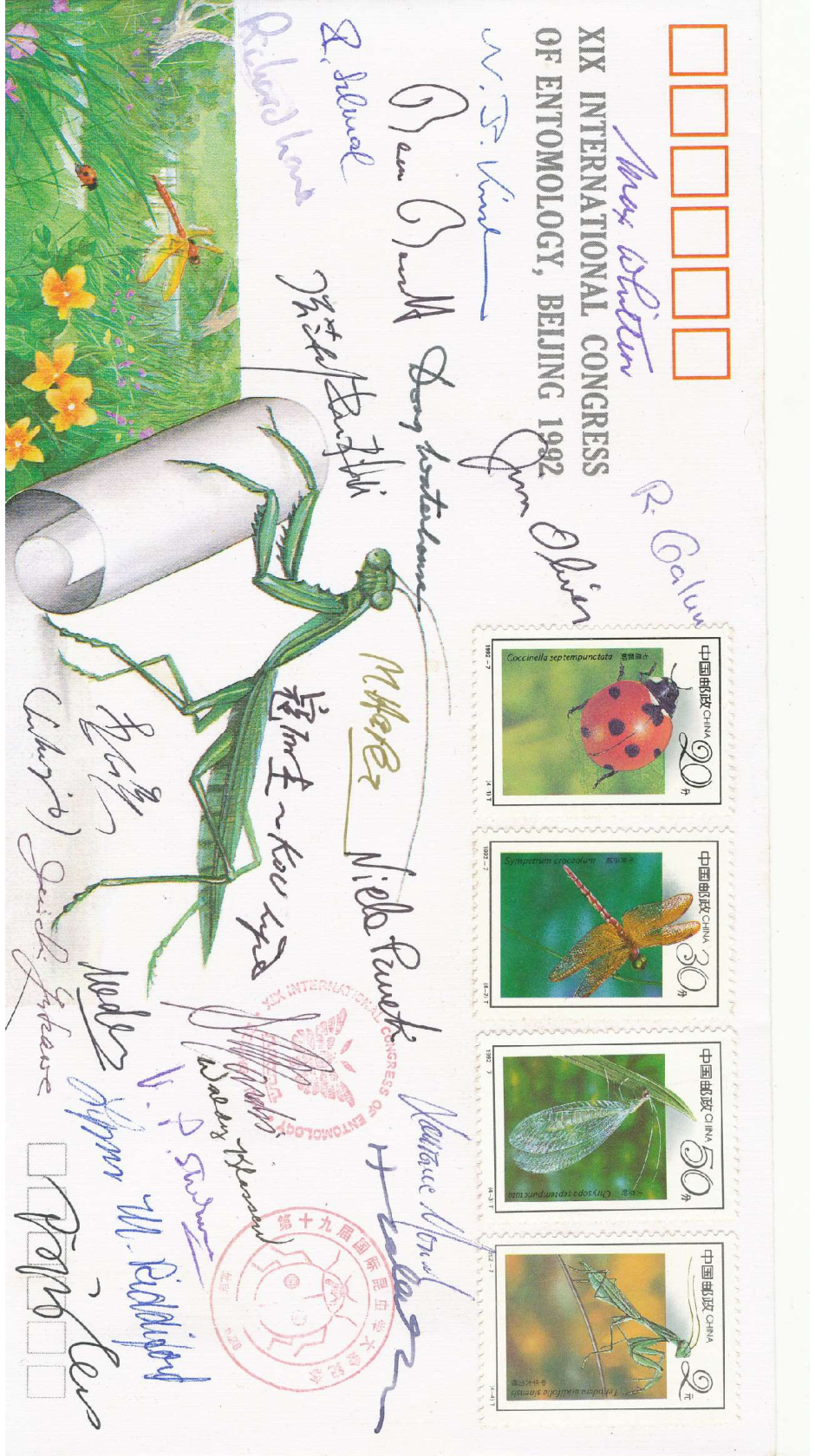
Logo for 1992 Beijing 19th ICE (cont’d)

“The History of the Silkworm, also the story of Silk, goes back to ancient times in China. The most common tale on the origins of the Silkworm begins in 2640 B.C. when Si-Ling-Chi, a Chinese Empress was simply walking through her garden, when a ‘cocoon’ (of a Silkworm) dropped into her tea. Upon picking it up, she found the cocoon begun to unravel, forming a beautiful string of what is now known as ‘Silk’ “. https://everythingsilkworms.com.au/
“The production of silk originated in China in the Neolithic period (Yangshao culture, 4th millennium BC). Silk production remained confined to China until the Silk Road opened at some point during the later half of the 1st millennium BC, though China maintained its virtual monopoly over silk production for another thousand years”. (extract Wikipedia)
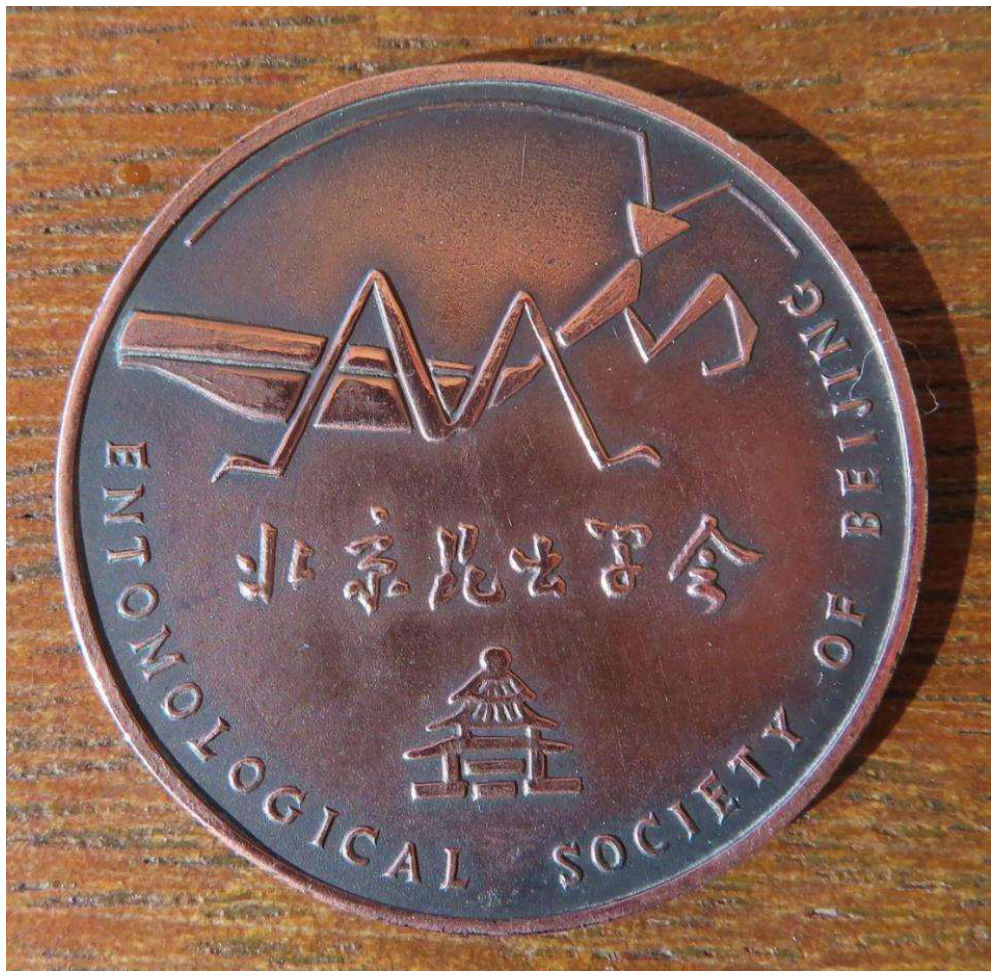
Medallion of the Entomological Society of Beijing, given to Max Whitten probably in 1991, but possibly during the ICE in 1992.
1996 · Florence
Logo for 1996 Florence 20th ICE
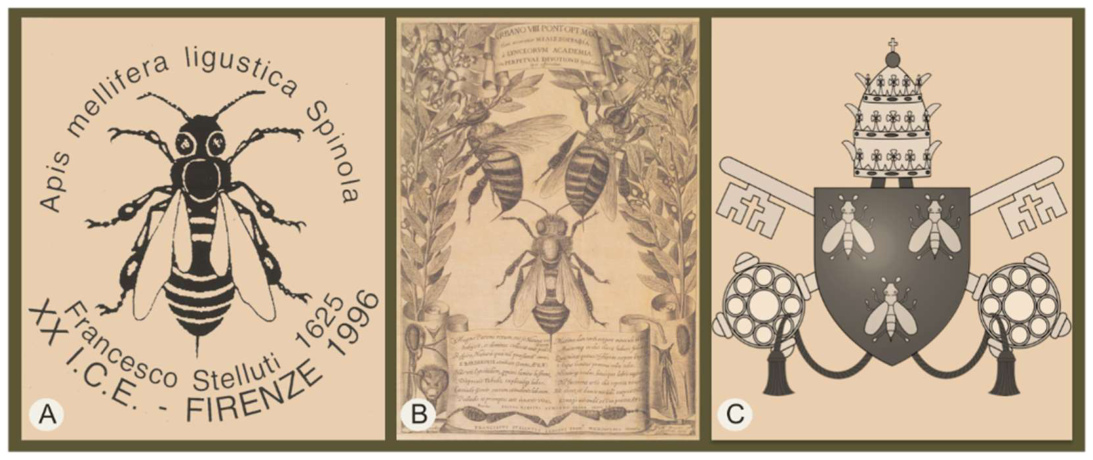
“The honey bee logo chosen for the 1996 Florence ICE (Fig A) has a fascinating history and it well illustrates the eternal quest by scholars over the centuries to find benefactors, in this instance ‘protectors’, to support their endeavors in a climate suspicious of scientific enquiry. Federico Cesi and fellow polymath Francesco Stelluti were the first to use Galileo’s newly invented compound microscope to explore ‘never-seen-before’ details of insects. Strategically, they chose the honey bee, Apis mellifera L., and illustrated their drawings in the 1625 broadsheet “Melissografia” (incised by Matthias Greuter) (Fig B), in the style of the crest (Fig C) of a potential powerful patron, Cardinal Maffeo Barberini, born in Florence, who was a friend of Galileo and had just ascended to the papacy as Urbano VIII. This anticipated the publication in the first weeks of 1626 of the impressive monograph “Apiarium”, which was the first biological publication in the world based on microscopic observations. The “Apiarium” was donated to Urbano VIII, and shared only with Galileo Galilei in Firenze, Fabio Colonna and Mario Schipani in Napoli, and with a very limited number of unknown scientists in Germany.” Extract from Chapter 12 in “History of International Congresses of Entomology” authored by Romano Dallai and Francesco Pennacchio. (In press)
2000 · Iguaçu Falls
Logo for 2000 Iguacu Falls 21st ICE
“Entomologists Preserving Biodiversity”
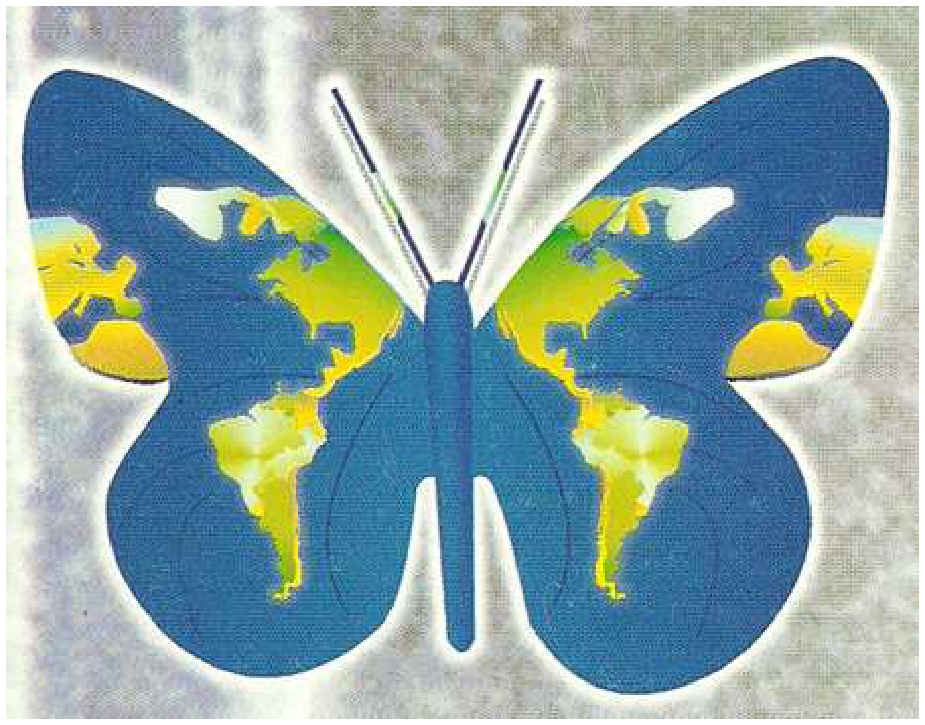
A logo was designed on a Papilio butterfly with a global motif centered on the South American Continent. This image was chosen because of the richness of the butterfly fauna in the neotropics, especially at the Iguacu Falls. A continuing theme of the Iguacu Congress was biodiversity and conservation, reflecting the fact that Brazil was the host country for the 1992 Convention on Biological Diversity.
2004 · Brisbane
The Logo for the 2004 Brisbane 22nd ICE
“Strength in Diversity”
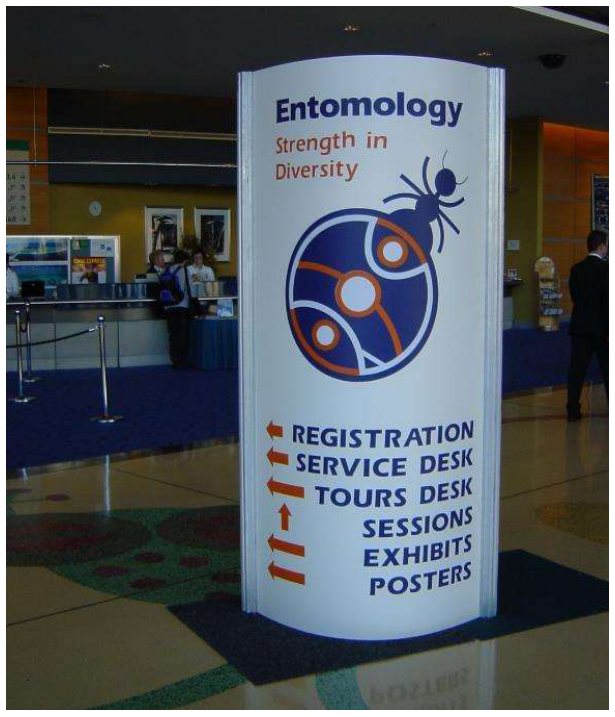
“A stylized representation of the Honeypot ant featuring Australia was the logo chosen to identify ICE XXII. Long before the consumption of insects became fashionable (and perhaps even a necessity in the future) Australia’s first peoples, for tens of thousands of years, had been eating them, including the Honeypot ant (Melophorus bagoti Lubbock). This ant belongs to a group of desert species where food resources, in this instance nectar harvested by foragers, are stored in specialized workers called repletes. These suspended ‘living larders’ supply the colony in lean times. It is reputed that desert dwelling Aboriginal people located the nest and feasted on the bloated repletes. Of particular interest to entomologists is the capacity of the foraging workers not to use pheromone trails, unreliable in the shifting sands, but to ‘re-compute’ their location in relation to the nest on each change of direction during foraging. That clever strategy allows the lone forager to scamper back home by the shortest route in a featureless landscape”.
Extract from Chapter 14 in “History of International Congresses of Entomology” authored by Meron Zalucki. (in press)
The Logo for the 2004 Brisbane 22nd ICE
“Strength in Diversity”
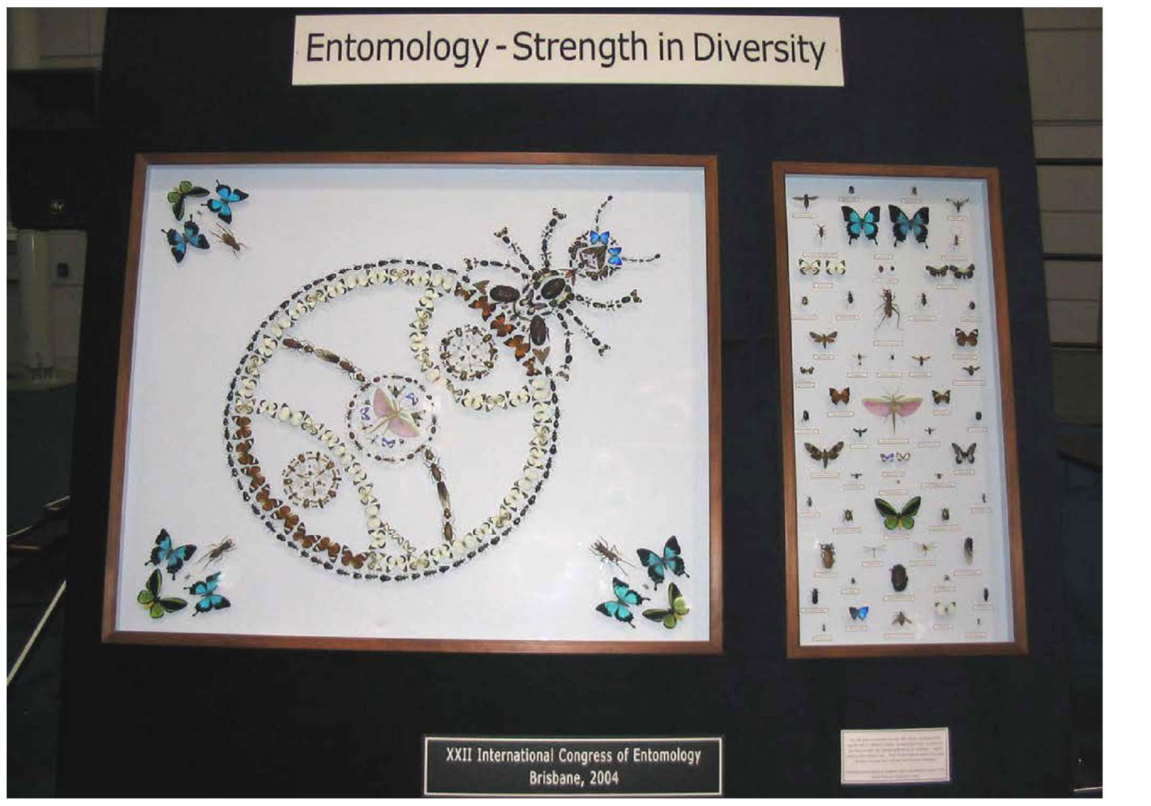
This diorama, depicting the logo for the Brisbane ICE, was made by students and staff at the University of Queensland; and comprises butterflies and other insects. The diorama now hangs on display in the School of Biological Sciences.
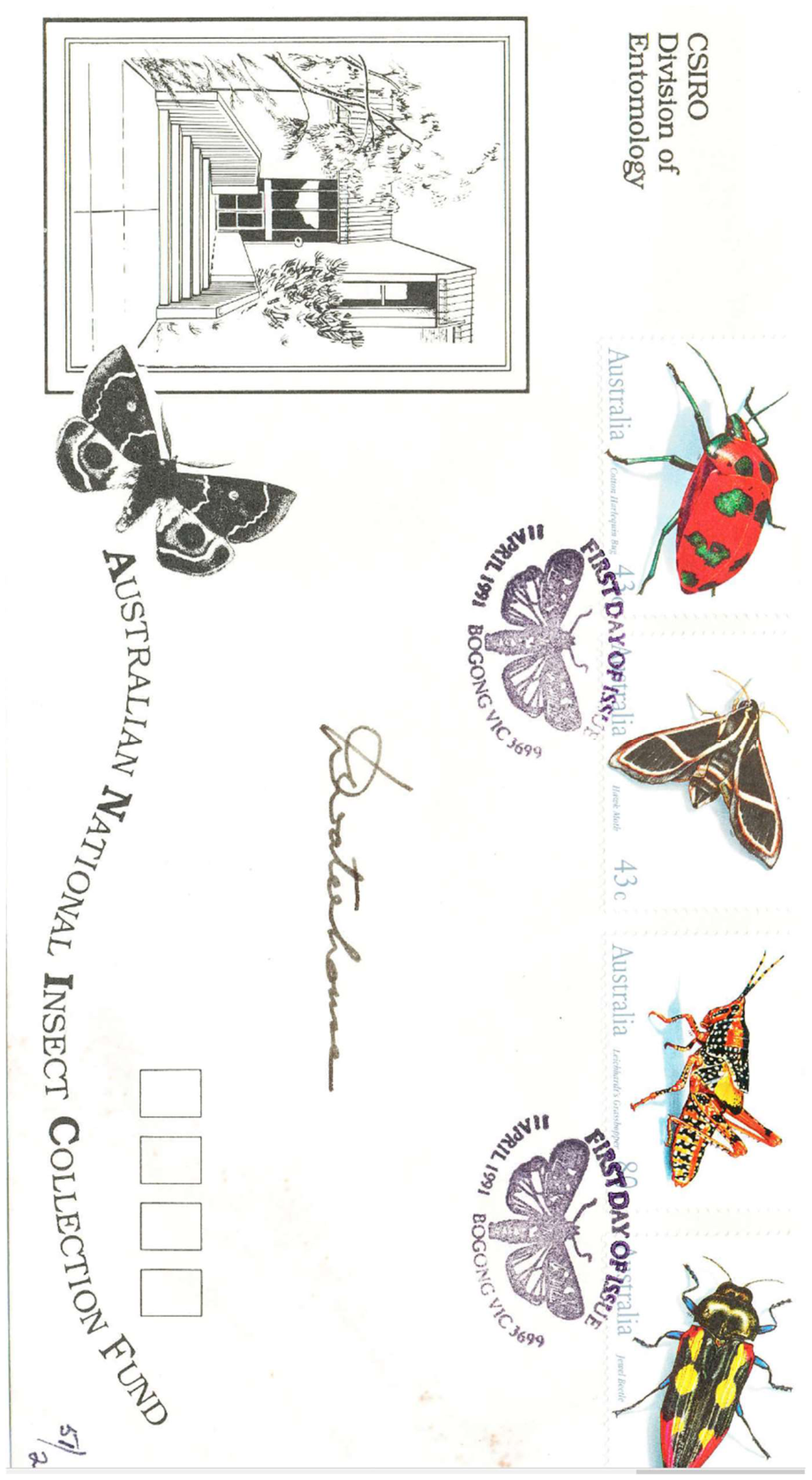
2008 · Durban
The Logo for the 2008 Durban 23rd ICE
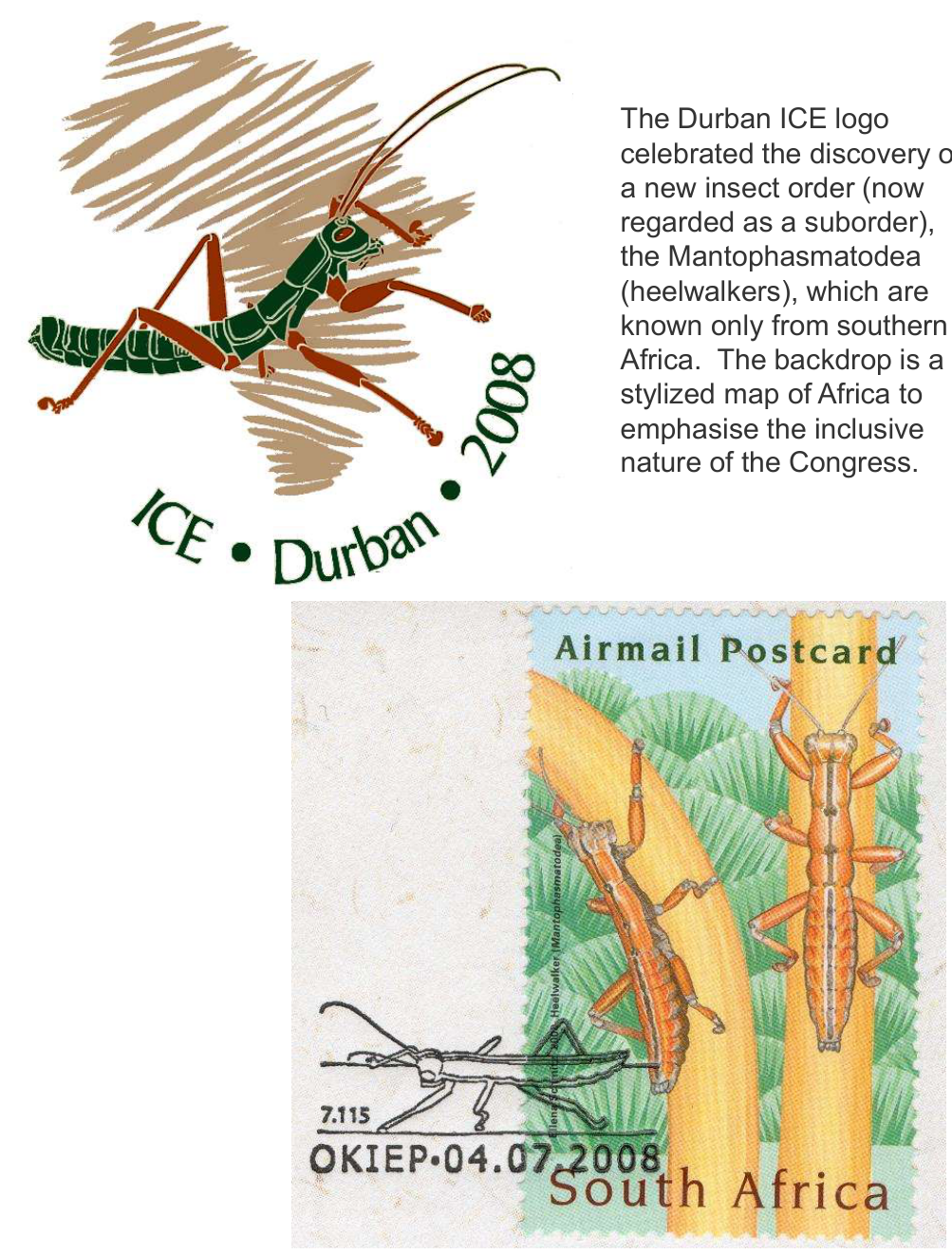
The congress was privileged to host the issuing of a new stamp by the South African Postal Services, commemorating the Mantophasmatodea (heelwalkers). A first-day issue of the stamp was on sale at the congress.
2012 · Daegu
2016 · Orlando
Logo for the 2016 Orlando 25th ICE
“Entomology without Borders”

“A Congress logo was selected to complement the theme. Consideration was given to several orders of insects that are common in Florida, the host state. However, a dragonfly was selected because of its wide diversity and abundance of the group in Florida and because of the image of energy, determination and elegance that we believe it conveys. A photograph of an unidentified dragonfly was used as a model for the insect image in the logo. The bright blue and green in the design highlight the city of Orlando, while incorporating Earth, along with the dragonfly that appears to be zipping round the world – without borders!”
Extract from Chapter 17 in the “History of International Congresses of Entomology” authored by Alvin M. Simmons and Walter S. Leal. (in press)
2022 · Helsinki
The Logo for the 2022 Helsinki 26th ICE
“Entomology for our Planet”
COVID-19 continues to impact on the 26th ICE.
2024 · Kyoto

The call for logo designs opened on 9 April 2018, and the logo was selected by a vote at the Union of Japanese Societies for Insect Sciences on 15 September 2018. The logo is inspired by the wings of a swallowtail butterfly. The space between the wings forms a five-storey pagoda, while the two sides of the wings depict people facing one another. The blue colour is known as “Japan Blue”, a colour frequently used in ukiyo-e prints. The white lines represent lines of longitude and latitude. Together, these elements symbolise entomologists from around the world gathering in Kyoto.